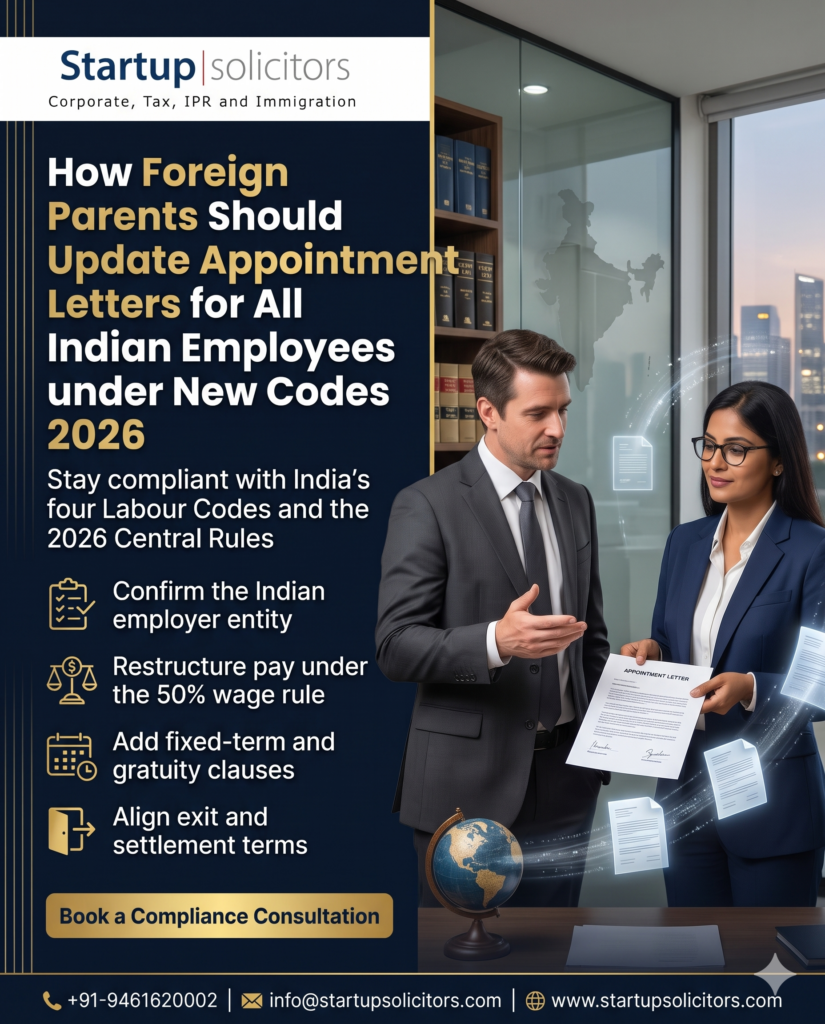
Is your Indian subsidiary still issuing offer letters drafted before 2025? Updating appointment letters under new labour codes is now a priority for every foreign parent company, global startup, MNC and NRI-led business employing people in India. The four Labour Codes came into force on 21 November 2025, replacing 29 central labour laws. The Central Rules were notified on 8 May 2026, and they prescribe the format and particulars of the appointment letter.
The risk usually sits at the parent level. Global HR teams often send template contracts from headquarters, and those templates may ignore India’s wage definition, gratuity rules and settlement timelines. This guide explains what to change, why it matters and how to do it in an orderly way. It reflects the practical compliance work Startup Solicitors LLP sees across foreign-owned Indian entities.
Understanding Appointment Letters in the Indian Context
An appointment letter is the written record of employment terms. Under the Occupational Safety, Health and Working Conditions Code, 2020 (OSH Code), every employer must issue one to every employee. That includes permanent, fixed-term and contract staff, which is why it is no longer a matter of HR preference.
The legal employer for Indian staff is normally the Indian subsidiary, LLP or registered branch, not the foreign parent. Parent companies that set up a private limited company as a wholly owned subsidiary should issue letters in the subsidiary’s name. Direct employment by an overseas entity can create tax, social security and permanent establishment exposure.
Key terms used across all four Codes now share common definitions. These include “wages”, “employee”, “worker” and “establishment”. A single appointment letter must therefore align with the Code on Wages, the Code on Social Security, the Industrial Relations Code and the OSH Code together.
Legal Framework and Regulations in India
The four Codes and the 2026 Central Rules form the core framework:
| Law | Relevance to appointment letters |
|---|---|
| Code on Wages, 2019 | Uniform “wages” definition, 50% rule, timely payment |
| Code on Social Security, 2020 | PF, ESI, gratuity, fixed-term benefits |
| Industrial Relations Code, 2020 | Fixed-term employment, notice, termination terms |
| OSH Code, 2020 | Mandatory appointment letter, working hours, health and safety |
Three changes matter most for drafting:
- Wages definition: “Wages” (basic pay, dearness allowance and retaining allowance) must generally make up at least 50% of total remuneration. Excluded allowances above that threshold are added back. This increases the base for PF and gratuity.
- Fixed-term gratuity: Fixed-term employees become eligible for pro-rata gratuity after one year of service, instead of five.
- Final settlement: Dues must be settled within two working days of exit.
Labour is a concurrent subject, so state rules also matter. Confirm the position in the state where each employee works. Foreign companies should also keep their filings consistent with the Ministry of Corporate Affairs and income tax requirements on the Income Tax portal. Ongoing corporate governance compliance should reflect any revised HR documentation.
Step-by-Step Process to Update Appointment Letters
- Audit existing letters. List every Indian employee, employing entity, contract type and salary structure.
- Confirm the legal employer. Letters must come from the Indian entity, not the parent.
- Restructure pay components. Test each CTC against the 50% wages rule and recompute PF and gratuity exposure.
- Map to the prescribed format. Include the particulars required by the OSH Rules, such as designation, joining date, wage components, working hours and social security coverage.
- Add fixed-term clauses. State the contract period, pro-rata gratuity and parity with permanent staff.
- Update exit terms. Align notice, resignation and the two-working-day settlement timeline.
- Issue and record acknowledgement. Keep signed or e-signed copies, and an updated handbook where needed.
Stakeholder-specific considerations:
- Indian residents: Re-papering is required, and employees should be told how the revised structure affects take-home pay.
- NRIs: An NRI founder employing staff in India needs the Indian entity as employer and must meet FEMA and RBI compliance for funding and remittances.
- Foreign companies: Expatriates and seconded staff need separate secondment or local employment terms. See employment visa applications for foreign hires.
- Global startups: Those still planning company setup in India should build Code-compliant templates before the first hire.
- Overseas investors: Diligence should check whether appointment letters meet Code requirements, since non-compliance can reduce valuation.
Key Challenges and Practical Issues
- Template reuse: Headquarters templates that use fixed allowances and low basic pay no longer fit the wages definition.
- Wage restructuring: Moving to a 50% structure raises employer PF and gratuity cost and may lower monthly take-home pay. Poor communication creates attrition.
- Mixed workforces: Contractors, consultants and fixed-term hires can be misclassified.
- Documentation gaps: Missing acknowledgements make it hard to prove compliance in an inspection or dispute.
- State variations: State rules may differ on specific procedures.
- Data handling: Employee data collected for letters must follow the Digital Personal Data Protection framework.
Many foreign groups doing company formation in India focus on incorporation and treat HR documents as an afterthought. That is when exposure builds.
Strategic Insights and Expert Recommendations
- Create one global-to-India template. Keep parent policies in a separate annexure so the Indian letter stays compliant on its own.
- Model cost before communicating. Run a payroll simulation using payroll management support so budgets, not surprises, drive decisions.
- Treat fixed-term staff as a planned liability. Provide for pro-rata gratuity in project budgets.
- Align tax and HR. Salary restructuring affects TDS and taxation and compliance planning, so coordinate both.
- Use legal review at group level. Legal advisory on corporate law helps check employment, confidentiality and IP clauses together.
- Build a compliance calendar. Track Rule updates, state notifications and annual reviews through compliance monitoring and reporting.
Foreign parents that need a complete structure can review options for business setup in India for foreign nationals. Subsidiary structuring is covered under subsidiary company registration, and local leadership under resident director appointment. Startups can also check eligibility for Startup India registration through the DPIIT portal.
Conclusion
Updating appointment letters under new labour codes is a compliance and cost-planning exercise, not just a drafting task. Foreign parents should confirm the Indian employer, restructure wages, add fixed-term and exit clauses, and keep proof of issuance. Doing this early reduces inspection risk, protects investor confidence and supports hiring at scale.
If your group needs a structured review, Startup Solicitors LLP can assist. You can contact the team to discuss your Indian workforce documentation.
Disclaimer: This article is for general information only and is not legal advice. Check state rules and the latest notifications before acting.
Connect: Website | Contact | LinkedIn | Substack | Instagram
FAQs
1. Is an appointment letter mandatory for all employees in India in 2026?
Yes. The OSH Code requires employers to issue a written appointment letter to every employee, including fixed-term and contract staff. The 2026 Central Rules prescribe the format and particulars. Issuing it before or at joining and keeping an acknowledgement is the safest practice.
2. Can a foreign parent company issue appointment letters directly to Indian employees?
It is possible but risky. The Indian subsidiary or registered entity should normally be the employer. Direct employment by an overseas parent can trigger tax, social security and permanent establishment issues. Seconded expatriates need separate secondment documentation.
3. What is the 50% wage rule, and how does it affect appointment letters?
Under the Codes, “wages” (basic pay, dearness allowance, retaining allowance) must generally be at least 50% of total remuneration. Letters must therefore show a compliant salary breakup, which increases PF and gratuity contributions and may change take-home pay.
4. Are fixed-term employees entitled to gratuity under the new Codes?
Yes. Fixed-term employees become eligible for pro-rata gratuity after completing one year of service under the contract. Appointment letters for such roles should state the contract period, benefit parity with permanent staff and the gratuity position clearly.
5. Do NRIs and overseas investors running Indian companies need to update letters?
Yes. The obligation depends on the employing Indian entity, not the owner’s residency. NRIs and overseas investors should ensure every Indian employee holds a Code-compliant letter, and that funding and remittances follow FEMA and RBI rules.