Setting up a Grievance Redressal Committee under Labour Codes is now a core compliance task for any foreign subsidiary in India with 20 or more workers. Many global parent companies assume their HR policy or whistleblower hotline is enough. Under Indian law, it is not. The Industrial Relations Code, 2020 requires a structured, balanced committee with fixed timelines and documented outcomes.
This guide is for foreign companies, NRIs, MNCs, global startups and overseas investors who have completed Company Formation In India and now need to run people operations correctly. It explains who must comply, how the committee must be built, and where subsidiaries usually go wrong. Startup Solicitors LLP regularly sees these gaps during post-incorporation compliance reviews, so the practical points below come from common patterns rather than theory.
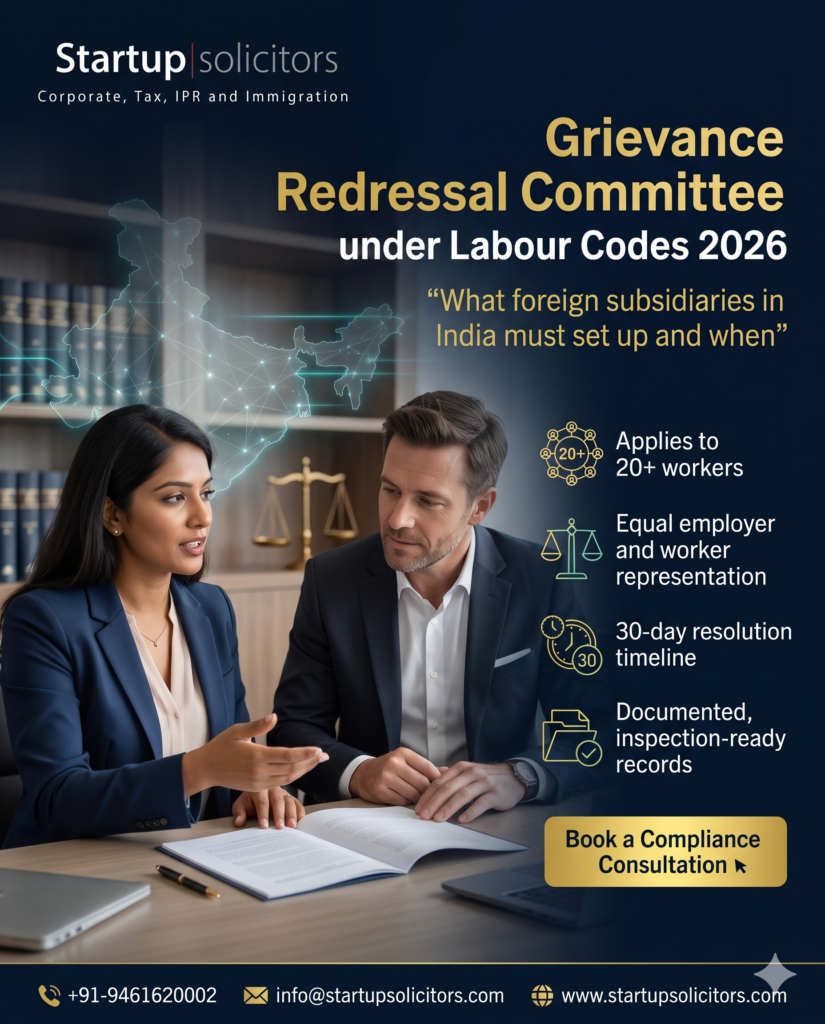
Understanding the Grievance Redressal Committee in the Indian Context
A Grievance Redressal Committee (GRC) is an internal body that resolves individual workplace grievances before they escalate into formal industrial disputes. Under the Industrial Relations Code, 2020 (Section 4), every industrial establishment employing 20 or more workers must have one or more such committees.
The Indian approach differs from the Western model. In the US or UK, grievance handling is usually an HR-led process. In India, the law prescribes the committee’s structure, and it includes worker representatives, not only management nominees. For a foreign parent, this means the committee cannot be a copy of the global ethics panel.
The four Labour Codes (Wages, Industrial Relations, Social Security, and Occupational Safety, Health and Working Conditions) were brought into force on 21 November 2025, consolidating 29 earlier central labour laws. Because labour is a concurrent subject, states also notify their own rules, so the exact procedure can vary by location.
Legal Framework and Regulations in India
The main provisions to know:
| Requirement | What the Industrial Relations Code provides |
|---|---|
| Applicability | Industrial establishments with 20 or more workers |
| Size | Not more than 10 members |
| Composition | Equal representation of employer and workers |
| Chairperson | Chosen alternately from employer and worker sides |
| Women’s representation | In proportion to the number of women workers |
| Member term | Up to three years |
| Time to raise a grievance | Within one year of the cause of action |
| Time to resolve | Within 30 days of receiving the application |
The Code covers individual grievances. Collective disputes, retrenchment and closure follow separate procedures under the same Code. The Internal Committee under the POSH Act, 2013 is a different body and cannot replace the GRC.
For foreign-owned entities, the subsidiary’s corporate record must also be in order. The Ministry of Corporate Affairs portal holds the company master data, and wage and payroll records feed into tax compliance on the Income Tax portal. Foreign shareholding and reporting obligations sit alongside this under FEMA and RBI compliance.
Step-by-Step Process Explained
- Count your workers. Determine headcount at each establishment, including fixed-term employees, who are treated as workers for benefits under the Code. Confirm separately how contract and platform workers are counted under your state’s rules.
- Check the worker definition. Managerial and supervisory staff above the prescribed wage threshold fall outside “worker.” Map each role correctly.
- Fix the committee size. Choose an even number of members, up to 10, so employer and worker sides are equal.
- Select worker representatives. Use a documented, transparent process such as nominations or election, with a record of it. Where a recognised union exists, coordinate with it.
- Ensure women’s representation. Seats must reflect the share of women among workers.
- Appoint a rotating chairperson. Record the rotation schedule in the committee charter.
- Notify employees. Publish the committee details, filing method and timelines on notice boards and the intranet.
- Run and document. Log every grievance, hearing and decision, and close each within 30 days.
Considerations by stakeholder:
- Indian residents (founders and local owners): You usually run both the board and the committee. Keep management representatives on the committee clearly separate from board decision-makers to avoid conflicts.
- NRIs: If you hold equity but are abroad, name a resident officer responsible for compliance. Statutory duties cannot be performed remotely without a local point of accountability, and a resident director appointment is often the practical route.
- Foreign companies: Align the global code of conduct with Indian law. Where the two conflict, the Indian statute prevails for Indian workers.
- Global startups: A small India team may cross 20 workers faster than expected after rapid hiring. Build the committee before the threshold, not after.
- Overseas investors: Add GRC compliance to due diligence checklists. A missing committee signals wider governance weakness, which matters during due diligence and compliance audits.
If you are still at the Company Setup in India stage, plan these obligations alongside private limited company registration or a business setup for foreign nationals, so HR structures are ready on day one.
Key Challenges and Practical Issues
- Copying the global ethics policy. A parent-company hotline does not satisfy the statutory structure.
- Management-heavy committees. Seats filled only by HR and finance heads break the equal representation rule.
- No written selection record. Worker representatives chosen informally are hard to defend later.
- Missed 30-day deadline. Slow decisions are the most common avoidable breach.
- Weak documentation. Without minutes and decision logs, the subsidiary cannot show compliance during inspection.
- State rule variations. Procedure details differ across states, and central and state rules may still be evolving, so check current notifications.
- Confusing overlapping committees. The GRC, POSH Internal Committee and data privacy grievance channels serve different purposes. Data complaints fall under DPDPA compliance.
Strategic Insights and Expert Recommendations
- Treat the GRC as an early-warning system. Patterns in grievances, such as wage queries or shift disputes, reveal problems before they become litigation.
- Draft a short committee charter. Cover selection, rotation, confidentiality, timelines and escalation. A two-page document prevents most disputes about process.
- Integrate with payroll. Many grievances are wage-related, so connect the process with payroll management to resolve errors quickly.
- Put it inside your governance calendar. Review committee activity quarterly under your corporate governance compliance programme and report trends to the board.
- Use alternatives for escalated matters. Where grievances turn into claims, mediation and negotiation often resolves matters faster than formal proceedings.
- Review employment contracts. Align offer letters and policies with the Codes, with corporate law and legal advisory support where roles cross borders. Foreign staff also need correct employment visa documentation.
For policy context on investment and startup recognition, the DPIIT website is a useful reference.
Conclusion
The Grievance Redressal Committee under Labour Codes is a legal requirement, but it is also good risk management. Foreign subsidiaries that build a balanced, documented committee early avoid inspection issues, protect employee relations and show investors a mature compliance culture. Check headcount, form the committee, document everything and resolve cases within the statutory timeline.
Requirements vary by state and are still being refined through rules, so confirm current notifications before finalising your structure. If you want a second opinion on your India HR compliance setup, you can contact Startup Solicitors LLP. Follow us on LinkedIn, Substack and Instagram, or visit startupsolicitors.com.
3. FAQs
Q1. Who must set up a Grievance Redressal Committee in India?
Every industrial establishment employing 20 or more workers must form one under Section 4 of the Industrial Relations Code, 2020. This applies equally to Indian companies and foreign subsidiaries. Headcount is assessed per establishment, so multi-location businesses should check each site separately.
Q2. How many members can the committee have?
The committee can have a maximum of 10 members, with equal representation from employer and worker sides. Women must be represented in proportion to their share among workers. The chairperson is selected alternately from employer and worker representatives, and members serve terms of up to three years.
Q3. What is the deadline to resolve a grievance?
The committee must complete its proceedings within 30 days of receiving the application. A worker should raise the grievance within one year of the cause of action. Delays beyond 30 days can expose the establishment to compliance issues, so maintain a dated register.
Q4. Does a foreign parent’s global grievance policy satisfy Indian law?
No. A global ethics or whistleblower policy does not meet the statutory structure, which requires balanced worker representation and fixed timelines. Foreign subsidiaries can keep the global policy for ethics matters but must run a separate Indian committee for worker grievances.
Q5. Is the GRC the same as the POSH Internal Committee?
No. The GRC handles individual workplace grievances under the Industrial Relations Code, while the Internal Committee under the POSH Act, 2013 handles sexual harassment complaints. Their composition, procedure and legal basis differ, so an establishment must maintain both where applicable.