Board meeting compliance for a wholly owned subsidiary in India 2026 is one of the most critical — and most overlooked — governance responsibilities that foreign parent companies, MNCs, and global investors face after completing their company setup in India. The excitement of incorporation fades quickly when the Registrar of Companies compliance clock starts ticking.
If your wholly owned subsidiary (WOS) was incorporated in 2026 — whether you are a US tech company, a European manufacturing group, an Australian services firm, or an NRI-led venture — Indian law imposes strict timelines for board meetings, quorum requirements, agenda items, and filing obligations from Day One.
Missing a single meeting or filing the wrong form on the wrong date can attract penalties under the Companies Act, 2013, trigger ROC scrutiny, and create complications for future FDI compliance, dividend repatriation, and FEMA approvals. This guide gives you a precise, actionable, legally grounded first-year board meeting calendar — so your subsidiary stays compliant, audit-ready, and operationally sound.
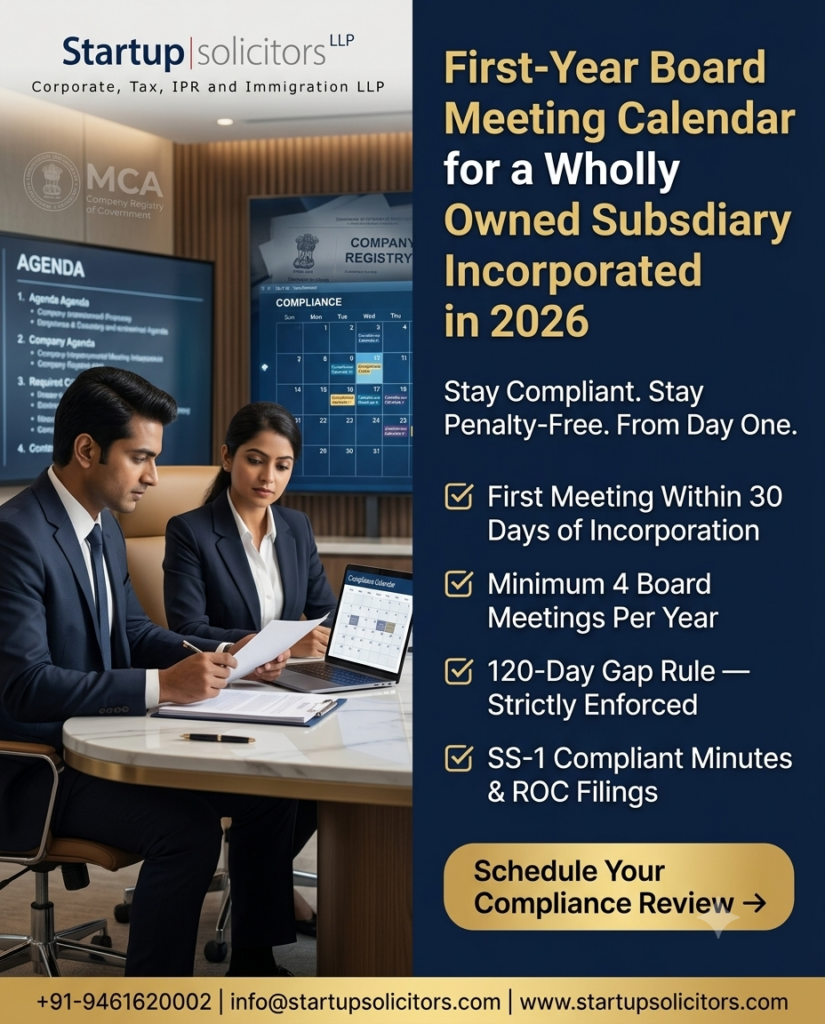
Understanding Board Meeting Requirements for a Wholly Owned Subsidiary in India
A wholly owned subsidiary incorporated in India is a private limited company under the Companies Act, 2013, regardless of whether the parent is Indian or foreign. The governance structure — including board meeting frequency, quorum, and agenda — is governed by Sections 173, 174, and 177 of the Companies Act.
Key baseline rules every WOS must know:
- Minimum 4 board meetings per year, with a maximum gap of 120 days between any two consecutive meetings
- First board meeting must be held within 30 days of incorporation
- Notice of 7 clear days must be given before each board meeting (shorter notice allowed with consent of directors)
- Quorum: One-third of total strength or 2 directors, whichever is higher
- Minutes must be recorded in the Minutes Book within 30 days of the meeting
For foreign companies undertaking company formation in India through a wholly owned subsidiary structure, these compliance obligations begin immediately upon incorporation — not after the first financial year ends.
Legal Framework & Regulations Governing WOS Board Meetings in India
The primary legislation and regulatory framework includes:
| Legal Instrument | Relevance |
|---|---|
| Companies Act, 2013 — Section 173 | Board meeting frequency and notice |
| Companies Act, 2013 — Section 174 | Quorum requirements |
| Companies Act, 2013 — Section 118 | Minutes of board meetings |
| Companies Act, 2013 — Section 179 | Powers exercisable at board meetings |
| Secretarial Standards — SS-1 | ICSI Standards on Board Meetings (mandatory) |
| FEMA / RBI Regulations | Applicable for FDI-funded subsidiaries |
| Income Tax Act, 1961 | PoEM (Place of Effective Management) — board meeting location matters |
A critical but often missed point: for subsidiaries funded through FDI, the Ministry of Corporate Affairs and RBI/FEMA compliance requirements interact. The location where board meetings are held influences India’s Place of Effective Management (PoEM) rules under the Income Tax Act — which can determine whether the entity is treated as an Indian resident for tax purposes.
If you are establishing a WOS as part of business setup in India for foreign nationals, integrating PoEM-conscious board meeting planning from Year One is essential.
Step-by-Step First-Year Board Meeting Calendar for a WOS Incorporated in 2026
Below is a practical, compliance-grounded calendar framework. Adjust dates based on your exact date of incorporation.
Assumption: WOS incorporated on 1 March 2026. First financial year ends 31 March 2027.
Meeting 1 — Within 30 Days of Incorporation (By 31 March 2026)
Mandatory Agenda Items:
- Appointment of first directors (if not done at incorporation)
- Appointment of Company Secretary (if applicable — mandatory for certain companies)
- Opening of bank account authorization
- Adoption of common seal (if applicable)
- Appointment of statutory auditor — mandatory within 30 days of incorporation (Section 139)
- Approval of registered office address
- Disclosure of interests by directors (Form MBP-1)
- Allotment of shares (if subscribers haven’t been allotted)
Filing Triggered: ADT-1 (Auditor appointment) within 15 days of meeting. If your company requires digital signature certificates for authorized signatories, ensure these are ready before this meeting.
Meeting 2 — By 30 June 2026 (Within 120 days of Meeting 1)
Agenda Items:
- Review of company setup progress — bank accounts, PAN, TAN, GST registration
- Review of GST registration status and compliance timeline
- Approval of business commencement steps
- Authorization for any initial contracts or vendor agreements
- Review of statutory registers
- Director KYC status — DIN compliance
Note for Foreign Parent: If the parent company’s nominee directors are attending from overseas, ensure video conferencing is properly minuted as per SS-1 requirements.
Meeting 3 — By 30 September 2026 (Within 120 days of Meeting 2)
Agenda Items:
- Review of Q1 financial position / management accounts
- GST return filing compliance review
- Transfer pricing documentation initiation (for international transactions with parent)
- Approval of any related party transactions with parent company
- Employee-related resolutions (if hiring has commenced) — including payroll management authorization
- Review of MSME registration eligibility and application status
Meeting 4 — By 31 December 2026 (Within 120 days of Meeting 3)
Agenda Items:
- H1 financial review — management accounts, revenue recognition
- Income tax return filing advance tax planning
- Statutory audit planning — appointment confirmation with auditor
- Review of corporate governance compliance status
- Any capital structure changes — additional FDI tranches, share allotments
- RBI/FEMA compliance — FC-GPR filings for FDI received
- Review of intellectual property registration status — trademark and other IP
Meeting 5 (Optional but Recommended) — January/February 2027
Agenda Items:
- Annual accounts preparation — authorization to draft financials
- Statutory audit commencement — information sharing with auditor
- Financial reporting compliance review
- AGM planning — First AGM must be held within 9 months of financial year end (31 December 2027 for a March 2027 year-end)
- Director re-appointments (if any rotational requirements apply)
- Review of accounting and internal auditing findings
First AGM — By 31 December 2027
The first Annual General Meeting must be held within 9 months from the close of the first financial year — i.e., by 31 December 2027 for a March 2027 year-end. At the AGM, the auditor is reappointed, financial statements adopted, and dividend (if any) declared.
Key Challenges and Practical Issues
1. Director Availability and Quorum Failures
Many WOS structures appoint nominee directors who are overseas. Frequent quorum failures due to time zones, travel restrictions, or last-minute unavailability are a real operational risk. A nominee director services arrangement with a qualified India-based director solves this structurally.
2. Improper Minutes Documentation
Minutes must comply with SS-1 (Secretarial Standards). Many first-year subsidiaries rely on informal notes — which can create serious audit and ROC issues. Minutes must record attendance, discussion, resolutions passed (by show of hands or poll), and dissenting views.
3. Missing the First Auditor Appointment Deadline
Failure to appoint a statutory auditor within 30 days of incorporation is a Section 139 violation. The Central Government can appoint an auditor on the company’s behalf — at the company’s cost — if this is missed.
4. PoEM Exposure from Poor Meeting Location Documentation
For MNC subsidiaries, if all substantive board decisions are effectively made at the parent company’s headquarters and merely rubber-stamped in India, Indian tax authorities may challenge PoEM. Board meeting minutes should reflect genuine deliberation by India-based decision-makers.
5. Related Party Transaction Non-Disclosure
Any transaction with the parent company — management fees, royalties, intercompany loans — must be pre-approved by the board and disclosed in the annual report. Non-disclosure triggers audit qualifications.
Strategic Insights & Expert Recommendations
1. Build a Compliance Calendar on Day One
Don’t wait for the first board meeting to plan the second. Create a 12-month compliance calendar immediately upon incorporation — mapping all board meetings, ROC filings, tax due dates, and FEMA obligations.
2. Appoint a Professional Company Secretary Early
For companies with paid-up capital exceeding ₹5 crore, a whole-time Company Secretary is mandatory. Even below this threshold, engaging a practicing CS significantly reduces compliance risk.
3. Integrate corporate law and legal advisory from Incorporation
One-time legal advice at incorporation is insufficient. Ongoing advisory aligned with your board calendar ensures every resolution is legally valid, properly authorized, and audit-proof.
4. Use Video Conferencing Strategically but Correctly
SS-1 and the Companies Act permit video conferencing for board meetings. However, certain items — like approval of financial statements and board’s report — cannot be passed through circulation resolutions and require an actual meeting.
5. Track the 120-Day Rule Rigorously
The 120-day gap rule between consecutive board meetings is absolute. No exemptions exist for startups or small companies (except the COVID-era relaxations, which are no longer in force). Build calendar reminders 30 days before each deadline.
6. Align Board Meetings with Tax and FDI Compliance Windows
Quarter-end board meetings naturally align with advance tax payment dates and FEMA reporting windows — making it operationally efficient to review both governance and regulatory compliance in a single sitting. Connect with Startup Solicitors LLP to design an integrated compliance calendar for your WOS.
Conclusion
Setting up a wholly owned subsidiary in India is a significant strategic decision — and maintaining board meeting compliance for your wholly owned subsidiary in India 2026 is the foundation of sustainable, penalty-free operations. The first year is especially critical: it establishes your compliance culture, satisfies ROC and tax authorities, protects your FDI structure, and signals governance maturity to potential partners, lenders, and regulators.
Whether you are a Fortune 500 MNC completing company setup in India or a growth-stage global startup expanding into one of the world’s largest markets, a well-planned first-year board meeting calendar is not optional — it is foundational.
Startup Solicitors LLP provides end-to-end corporate governance support for wholly owned subsidiaries across India, including board meeting management, secretarial compliance, FEMA reporting, and integrated legal advisory — so your India entity operates at the highest standards from Day One.
FAQ Section
Q1. How many board meetings are mandatory for a wholly owned subsidiary in its first year in India?
A minimum of 4 board meetings are required in every financial year under Section 173 of the Companies Act, 2013. The first meeting must be held within 30 days of incorporation, and no two consecutive meetings can be more than 120 days apart. For a new WOS, this typically means 4–5 meetings in the first financial year.
Q2. Can board meetings of an Indian WOS be held outside India?
Yes, there is no statutory bar on holding board meetings outside India. However, the Place of Effective Management (PoEM) provisions under the Income Tax Act make it advisable to conduct substantive board deliberations within India — particularly where key management decisions are being made — to avoid PoEM-related tax complications.
Q3. What is the penalty for not holding a board meeting within the stipulated time?
Under Section 173(4) of the Companies Act, 2013, every director who fails to comply with the board meeting requirements is liable to a penalty of ₹25,000. Repeated defaults can attract enhanced penalties and trigger ROC scrutiny of the company’s overall compliance posture.
Q4. Is a Company Secretary mandatory for a wholly owned subsidiary in India?
A whole-time Company Secretary is mandatory for companies with paid-up share capital of ₹5 crore or more. For smaller WOS entities, while not mandatory, appointing a practising CS for secretarial compliance significantly reduces risk and ensures SS-1-compliant minutes and filings.
Q5. What items must be compulsorily approved at board meetings and cannot be passed by circular resolution?
Several items cannot be passed through circulation under Section 175 — including approval of annual financial statements, the Board’s Report, and declaration of interim dividends. These require a physical or video conference meeting where directors are present. Many foreign companies underestimate this restriction in their first year.