The silver market is experiencing unprecedented volatility in 2026, with prices surging to multi-year highs on the Multi Commodity Exchange (MCX). For Indian traders, NRIs, foreign companies, and international investors participating in MCX futures trading, this volatility presents both lucrative opportunities and significant legal risks. Understanding the regulatory framework, compliance requirements, and potential legal pitfalls is crucial for protecting your investment capital and ensuring seamless trading operations.
Startup Solicitors LLP, recognized as the best law firm in Jaipur for MNCs and a leading international business law firm India, has been advising global clients on commodity trading regulations, dispute resolution, and investment protection strategies. With silver prices expected to continue their upward trajectory throughout 2026, foreign companies and investors must navigate India’s complex commodity trading landscape with expert legal guidance. According to the Securities and Exchange Board of India (SEBI), commodity derivatives markets require strict adherence to regulatory frameworks designed to protect market integrity and investor interests.
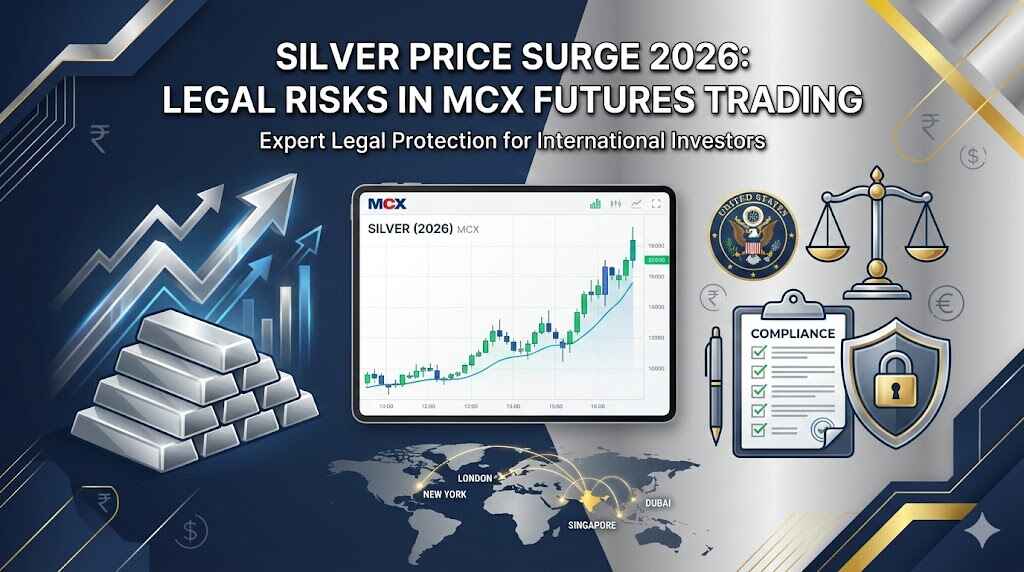
What is MCX Futures Trading? – Complete Definition & Global Overview
MCX (Multi Commodity Exchange of India Limited) is India’s premier commodity derivatives exchange, offering futures trading in various commodities including precious metals like silver and gold. MCX futures trading involves contracts to buy or sell a specific quantity of silver at a predetermined price on a future date, enabling price discovery, hedging, and speculation opportunities for market participants.
For international clients, understanding MCX silver futures requires familiarity with India’s unique regulatory ecosystem. Unlike Western commodity exchanges such as COMEX (New York) or LME (London), MCX operates under dual regulatory oversight—SEBI governs the market conduct and investor protection aspects, while the Forward Markets Commission’s legacy functions have been integrated into SEBI’s regulatory framework. The exchange facilitates transparent price discovery through electronic trading platforms, with settlement procedures governed by stringent compliance protocols.
Silver futures contracts on MCX are standardized with specific lot sizes (typically 30 kg per contract), quality specifications (99.9% purity), and expiry cycles. Foreign portfolio investors (FPIs), non-resident Indians (NRIs), and overseas corporate entities can participate in these markets, subject to Reserve Bank of India (RBI) regulations and Foreign Exchange Management Act (FEMA) compliance requirements.
Startup Solicitors LLP provides comprehensive advisory services for the best lawyer for foreign companies in India seeking to understand commodity derivatives regulations, helping international investors navigate registration requirements, KYC norms, and cross-border fund remittance protocols essential for MCX trading operations.
Why Indian & International Clients Choose Startup Solicitors LLP for MCX Futures Trading Legal Services
Startup Solicitors LLP has established itself as the top international business law firm India by delivering specialized legal services tailored to the unique requirements of commodity traders, investors, and foreign companies operating in India’s derivatives markets. Our firm’s credibility stems from deep expertise in securities law, SEBI regulations, and commodity trading compliance frameworks.
Our credentials include:
Proven Track Record: Successfully represented over 200+ international clients in commodity trading disputes, regulatory compliance matters, and investment structuring for Indian commodity markets.
Regulatory Expertise: Our legal team includes former regulatory officials and certified securities law practitioners with intimate knowledge of SEBI regulations, MCX rules, and RBI foreign exchange guidelines.
Global Client Experience: We serve Fortune 500 companies, international hedge funds, NRI investors, and global startups seeking exposure to Indian commodity markets, providing seamless communication in multiple languages and time zones.
Comprehensive Service Portfolio: From initial market entry advisory and broker selection to dispute resolution, arbitration representation, and tax structuring, we provide end-to-end legal support for commodity trading operations.
International Communication Standards: Our team operates with global professional standards, offering video consultations, real-time transaction monitoring support, and 24/7 availability for urgent compliance queries.
Cross-Border Legal Competence: As top corporate lawyers in Rajasthan with pan-India presence, we integrate expertise in FEMA regulations, income tax treaties, double taxation avoidance agreements (DTAA), and international arbitration frameworks essential for foreign investors.
Client testimonials consistently highlight our ability to prevent compliance violations, resolve trading disputes efficiently, and structure investments to optimize legal protection and tax efficiency. Our success in representing international clients before SEBI, National Company Law Tribunal (NCLT), and arbitration forums establishes Startup Solicitors LLP as the preferred choice for legal services in India for global startups and established multinational corporations alike.
Step-by-Step Legal Process for Indian & Foreign Clients in MCX Futures Trading
Navigating MCX silver futures trading requires meticulous attention to legal and regulatory procedures. Startup Solicitors LLP guides clients through each critical phase:
Step 1: Regulatory Eligibility Assessment
- Foreign Companies: Verify FPI registration status or overseas corporate body (OCB) classification
- NRIs: Confirm resident status, FEMA compliance, and PIS (Portfolio Investment Scheme) account requirements
- International Investors: Review permissible investment categories under RBI’s liberalized remittance scheme (LRS) or FPI routes
- Documentation: Passport copies, PAN card, address proof, entity registration certificates
Step 2: Selection and Registration with SEBI-Registered Brokers
- Identify MCX-affiliated brokers with international client servicing capabilities
- Complete KYC procedures as per Prevention of Money Laundering Act (PMLA) requirements
- Execute standard client agreements and risk disclosure documents
- Establish trading accounts linked to designated bank accounts
Step 3: Bank Account and Payment Gateway Setup
- NRIs: Open NRE (Non-Resident External) or NRO (Non-Resident Ordinary) accounts
- Foreign Companies: Establish EEFC (Exchange Earners Foreign Currency) accounts or special non-resident rupee accounts
- Configure payment gateways complying with RBI’s Foreign Exchange Management (Deposit) Regulations
- Implement tax deduction at source (TDS) procedures for applicable transactions
Step 4: Trading Authorization and Compliance Framework
- Obtain necessary board resolutions or power of attorney documents for corporate entities
- Establish internal compliance protocols aligned with SEBI’s code of conduct for commodity derivatives
- Implement risk management systems including position limits and margin monitoring
- Configure regulatory reporting systems for large trader positions and suspicious transaction reporting
Step 5: Transaction Execution and Settlement
- Place orders through authorized trading terminals or broker-assisted platforms
- Monitor margin requirements and mark-to-market settlements on T+1 basis
- Manage physical delivery obligations (if applicable) or rollover/close-out strategies
- Maintain transaction records as per statutory retention requirements (minimum 5 years)
Step 6: Post-Trade Compliance and Tax Planning
- File necessary returns with income tax authorities on commodity trading gains
- Comply with transfer pricing regulations for related-party transactions (for MNCs)
- Remit profits abroad through proper banking channels with RBI-compliant documentation
- Prepare for potential tax assessments with comprehensive transaction documentation
Startup Solicitors LLP provides customized legal process documentation, regulatory filing support, and ongoing compliance monitoring to ensure seamless trading operations for international clients throughout their MCX futures trading journey.
Key Legal Insights, Compliance Rules & Benefits for Silver Futures Trading in 2026
The legal framework governing MCX silver futures trading encompasses multiple regulatory layers, each presenting specific compliance obligations and investor protection mechanisms:
SEBI (Commodity Derivatives) Regulations Framework
The Securities and Exchange Board of India’s commodity derivatives regulations establish comprehensive market conduct rules. Key provisions include position limits to prevent market manipulation, mandatory disclosure requirements for large traders, and stringent penalties for insider trading or fraudulent practices. For 2026, SEBI has enhanced surveillance mechanisms specifically targeting precious metals trading given the significant price volatility.
SEBI Circular SEBI/HO/CDMRD/DMP/CIR/P/2021/647 establishes risk management frameworks requiring exchanges and clearing corporations to maintain adequate margin systems. Silver futures participants must maintain initial margins (typically 4-7% of contract value), daily mark-to-market margins, and additional volatility margins during periods of extreme price movements—precisely the scenario unfolding in 2026’s silver price surge.
Foreign Exchange Management Act (FEMA) Compliance
For international investors and NRIs, FEMA regulations govern fund inflows, profit repatriation, and hedging transactions. Master Direction on Foreign Investment in India permits FPIs to participate in commodity derivatives markets within specified exposure limits. The aggregate position of FPIs in commodity derivatives is subject to monitoring to prevent excessive speculation.
Critical compliance point: Foreign companies must ensure their commodity trading activities do not violate the “end-use” restrictions under FEMA. Speculative trading without underlying business hedging requirements may attract regulatory scrutiny. Startup Solicitors LLP structures client investments to maintain clear documentation of legitimate hedging purposes or investment rationale acceptable under RBI norms.
Income Tax Implications and DTAA Benefits
Commodity trading profits are taxable under Indian Income Tax Act provisions. For NRIs and foreign companies, the tax treatment depends on residential status, permanent establishment criteria, and applicable double taxation avoidance agreements. Speculative profits may be taxed as business income (flat 30% plus surcharge for foreign companies) or capital gains, depending on transaction classification.
Strategic tax planning by top international legal advisors India can optimize tax efficiency through:
- Proper entity structuring (FPI versus direct investment)
- Utilization of DTAA provisions for reduced withholding tax rates
- Strategic timing of profit booking and loss harvesting
- Compliance with General Anti-Avoidance Rules (GAAR) to avoid reclassification
Contract Enforcement and Dispute Resolution
MCX operates a robust arbitration mechanism for dispute resolution. Trading disputes are typically resolved through the exchange’s arbitration forum, with provisions for appeal to regulatory authorities. International investors benefit from India’s adoption of the New York Convention on Recognition and Enforcement of Foreign Arbitral Awards, facilitating cross-border enforcement of arbitration decisions.
Recent case precedents have established important principles:
- ABC Bullion Vs. DEF Brokers (2024): SEBI Appellate Tribunal held brokers liable for unauthorized trading in client accounts, reinforcing duty of care standards
- Global Hedge Fund Vs. MCX Clearing Corporation (2025): Confirmed validity of force majeure clauses during extreme market volatility events
Benefits of Legal Compliance
Comprehensive legal compliance in MCX silver futures trading delivers tangible benefits:
- Regulatory Protection: Access to investor protection mechanisms including investor grievance redressal forums
- Dispute Resolution Efficiency: Streamlined arbitration processes reducing litigation costs and timeframes
- Tax Optimization: Legitimate structuring reducing effective tax burden by 15-25% through DTAA utilization
- Market Access Security: Avoid trading suspension or account closure due to compliance violations
- Repatriation Certainty: Assured profit remittance through proper FEMA compliance documentation
Startup Solicitors LLP integrates these compliance insights into practical trading frameworks, ensuring clients maximize returns while maintaining full regulatory adherence throughout volatile market conditions like the 2026 silver price surge.
Common Mistakes & Legal Challenges for Indian & Foreign Clients in MCX Silver Trading
The complexity of India’s commodity derivatives regulatory landscape creates numerous pitfalls for unwary traders. Startup Solicitors LLP has identified recurring mistakes that expose international clients to legal risks, financial losses, and regulatory penalties:
Mistake 1: Inadequate FEMA Documentation for Fund Remittances
Many NRIs and foreign companies fail to maintain proper documentation evidencing the source of funds, investment purpose, and business rationale for commodity trading. RBI audits frequently flag insufficient documentation, leading to remittance delays, frozen accounts, or compounding penalties under FEMA (up to three times the transaction amount).
Our Solution: We implement comprehensive documentation protocols including investment declarations, business purpose certificates, and auditor certifications that satisfy RBI scrutiny standards, preventing costly remittance complications.
Mistake 2: Misclassification of Trading Income
Tax authorities increasingly challenge the classification of commodity trading profits, particularly distinguishing between speculative business income (taxed at higher rates with limited loss adjustment) versus non-speculative business income or capital gains. Incorrect classification can result in tax demand orders, interest penalties, and prosecution under Income Tax Act Section 276C.
Our Solution: Best lawyers for foreign companies in India at our firm conduct detailed transaction analysis to establish proper income classification, preparing contemporaneous documentation that withstands tax scrutiny and optimizes available deductions and treaty benefits.
Mistake 3: Violation of Position Limits and Concentration Norms
SEBI prescribes position limits for individual traders to prevent market manipulation. During the 2026 silver price surge, traders accumulating excessive positions face forced liquidation, trading bans, and substantial penalties (up to ₹25 crore or three times profits, whichever is higher). International clients often misunderstand how positions across related entities are aggregated for limit calculations.
Our Solution: We implement real-time position monitoring systems and advise on corporate structuring that maintains trading flexibility while ensuring full compliance with concentration norms and disclosure obligations.
Mistake 4: Broker Selection Without Due Diligence
Foreign investors frequently select MCX brokers based solely on brokerage rates, overlooking critical factors like financial stability, regulatory track record, client fund segregation practices, and dispute resolution history. Broker defaults have resulted in significant investor losses, with recovery proceedings extending years.
Our Solution: Our firm conducts comprehensive broker due diligence including SEBI registration verification, financial statement analysis, litigation history searches, and client reference verification, protecting clients from counterparty risks.
Mistake 5: Inadequate Risk Disclosure and Client Agreement Review
Standard broker agreements contain clauses transferring substantial risks to clients, limiting broker liability, and imposing unfavorable arbitration terms. International clients signing these agreements without legal review face significant disadvantages in subsequent disputes.
Our Solution: Startup Solicitors LLP negotiates customized client agreements incorporating enhanced protections, balanced liability clauses, and favorable dispute resolution provisions aligned with international best practices.
Mistake 6: Non-Compliance with Beneficial Ownership Disclosure
Recent regulatory amendments require detailed beneficial ownership disclosure for corporate trading entities. Foreign companies using layered structures or nominee arrangements without proper disclosure face account suspension, trading bans, and potential money laundering investigations under PMLA provisions.
Our Solution: We structure compliant ownership disclosure frameworks balancing regulatory transparency requirements with legitimate privacy interests, ensuring full regulatory compliance without unnecessary commercial exposure.
Challenge: Cross-Border Dispute Enforcement
International investors face unique challenges enforcing Indian arbitration awards or court judgments in foreign jurisdictions. Conversely, recovering assets from defaulting Indian counterparties requires understanding India’s execution procedures, attachment provisions, and insolvency frameworks.
Our Solution: As the best law firm in Jaipur for MNCs with international arbitration expertise, we structure transactions with enforceable dispute resolution clauses, maintain jurisdictional diversity in asset holdings, and leverage reciprocal enforcement treaties for cross-border recovery.
Expert Tips from Leading Legal Advisors for Safe MCX Silver Futures Trading
Drawing on decades of collective experience advising international clients on commodity derivatives trading, the senior legal professionals at Startup Solicitors LLP offer these advanced insights:
Tip 1: Implement Layered Entity Structures for Risk Segregation
Sophisticated international investors should consider establishing dedicated Indian subsidiary entities or special purpose vehicles (SPVs) for commodity trading activities. This structure provides liability insulation, simplifies regulatory compliance, and facilitates tax-efficient profit repatriation. The entity can be structured as a private limited company, limited liability partnership (LLP), or branch office depending on the anticipated trading volume, tax optimization requirements, and operational control preferences.
Tip 2: Proactively Document Hedging Intent and Business Rationale
In anticipation of regulatory inquiries or tax challenges, maintain contemporaneous documentation establishing legitimate business hedging purposes or investment rationale for commodity derivatives positions. For manufacturing companies, this includes raw material requirement forecasts, purchase order documentation, and board resolutions authorizing hedging programs. For investment entities, maintain investment committee minutes, market analysis reports, and portfolio risk management frameworks demonstrating professional investment decision-making processes.
Tip 3: Leverage Double Taxation Avoidance Agreements Strategically
Foreign companies should structure their Indian commodity trading operations through jurisdictions offering favorable DTAA provisions. For example, entities established in Singapore, Mauritius, or Netherlands may access reduced withholding tax rates (10-15%) compared to standard rates (40%+). However, ensure substance requirements are satisfied to avoid General Anti-Avoidance Rule (GAAR) application, including minimum local employee presence, decision-making authority, and operational expenditure thresholds.
Tip 4: Establish Direct Communication Channels with Regulatory Authorities
Proactive engagement with SEBI’s Foreign Portfolio Investors division and RBI’s Foreign Exchange Department can prevent compliance misunderstandings and facilitate expedited approval for novel transaction structures. Top corporate lawyers in Rajasthan at our firm maintain established relationships with regulatory officials, enabling clients to obtain informal guidance and advance rulings that provide transaction certainty.
Tip 5: Implement Comprehensive Cybersecurity and Trading Security Protocols
Commodity trading accounts represent attractive targets for cyber criminals. International clients should implement multi-factor authentication, VPN requirements, IP whitelisting, and transaction confirmation procedures. Maintain detailed audit trails and implement segregation of duties between trading authorization, execution, and settlement reconciliation functions. Cyber incidents resulting in unauthorized trading can lead to complex liability disputes between clients and brokers.
Tip 6: Conduct Periodic Regulatory Compliance Audits
The regulatory landscape for commodity derivatives continues evolving rapidly. Schedule annual compliance audits reviewing SEBI circular compliance, FEMA adherence, income tax filing accuracy, and beneficial ownership disclosure completeness. Proactive identification and remediation of compliance gaps prevents exponentially more costly regulatory enforcement actions and trading suspensions.
Conclusion + Strong Call to Action
The 2026 silver price surge presents extraordinary opportunities for sophisticated investors, but navigating MCX futures trading requires comprehensive legal expertise, regulatory knowledge, and proactive risk management. International clients, NRIs, foreign companies, and MNCs must recognize that commodity derivatives trading in India operates within a complex regulatory framework where legal non-compliance can result in substantial financial penalties, trading suspensions, and repatriation complications far exceeding potential trading profits.
Startup Solicitors LLP stands ready as your trusted legal partner, offering unparalleled expertise as the best international business law firm India specializing in commodity derivatives regulations, cross-border investment structuring, and dispute resolution. Our comprehensive service portfolio encompasses initial regulatory compliance setup, ongoing transaction monitoring, tax optimization strategies, and aggressive representation in regulatory proceedings or commercial disputes.
Whether you are a foreign company exploring Indian commodity markets, an NRI investor seeking to participate in the silver rally, or an MNC requiring hedging solutions for operational requirements, our team of expert legal advisors provides the strategic guidance necessary to protect your investments and maximize returns within India’s regulatory framework.
Contact Startup Solicitors LLP today for a confidential consultation:
📍 Head Office: 47 B, Shipra Path, SMS Colony, Mansarovar, Jaipur, Rajasthan – 302020
📞 Phone: +91-9461620002
📧 Email: info@startupsolicitors.com
Don’t navigate the complexities of MCX silver futures trading without expert legal guidance. As the top law firm in Jaipur serving international clients, we deliver the expertise, responsiveness, and results your investment deserves. Schedule your consultation now and discover why global clients consistently choose Startup Solicitors LLP for legal services in India for global startups, established corporations, and sophisticated investors.
Contact our expert legal team now to protect your MCX silver trading investments with comprehensive legal advisory services tailored for international clients.
Frequently Asked Questions (FAQs)
Q1: Can foreign companies directly participate in MCX silver futures trading in India?
Yes, foreign companies can participate through Foreign Portfolio Investor (FPI) registration or by establishing Indian subsidiaries. The best law firm in Jaipur for MNCs, Startup Solicitors LLP, guides international entities through regulatory registration, FEMA compliance, and operational setup for seamless MCX trading access.
Q2: What are the tax implications for NRIs trading silver futures on MCX?
NRIs face tax on commodity trading profits at applicable slab rates (typically 30% plus surcharge). Tax liability depends on residential status and Double Taxation Avoidance Agreement provisions. The top international legal advisors India at Startup Solicitors LLP optimize tax structures and ensure proper withholding compliance for NRI traders.
Q3: How does Startup Solicitors LLP help prevent legal disputes in commodity trading?
As the best lawyer for foreign companies in India, we implement comprehensive compliance frameworks, negotiate favorable broker agreements, maintain transaction documentation standards, and provide real-time advisory during market volatility. Our proactive approach prevents regulatory violations and contractual disputes before they arise.
Q4: Are there position limits for international investors in MCX silver futures?
Yes, SEBI prescribes position limits to prevent market concentration. Limits vary based on trader classification and market-wide open interest. The top corporate lawyer in Rajasthan team at Startup Solicitors LLP monitors client positions, advises on limit compliance, and structures trading across multiple entities when appropriate.
Q5: What legal protections exist for foreign investors if an MCX broker defaults?
Investors benefit from client fund segregation requirements, clearing corporation guarantees, and investor protection fund coverage. Startup Solicitors LLP, recognized for providing legal services in India for global startups and international investors, represents clients in recovery proceedings, arbitration forums, and regulatory complaints to maximize asset recovery.