
Choosing between a Private Limited Company and a Limited Liability Partnership (LLP) represents one of the most critical decisions foreign investors face when entering the Indian market. The Private Limited vs LLP for Foreign Investors debate has intensified in 2025, particularly as India continues positioning itself as a global business hub with investor-friendly policies and attractive tax incentives. International clients, NRIs, and multinational corporations must understand the nuanced differences between these structures to optimize tax savings, ensure compliance, and establish a strong operational foundation in India.
At Startup Solicitors LLP, Jaipur’s premier international business law firm, we specialize in guiding foreign investors through India’s complex corporate landscape. Our expertise extends across Rajasthan and throughout India, helping global clients make informed decisions that align with their business objectives while maximizing tax efficiency. Whether you’re an overseas entrepreneur exploring Indian markets or an established MNC planning expansion, understanding the Private Limited vs LLP comparison is essential for your success. According to the both structures offer distinct advantages, but the right choice depends on your specific business model, investment goals, and long-term vision.
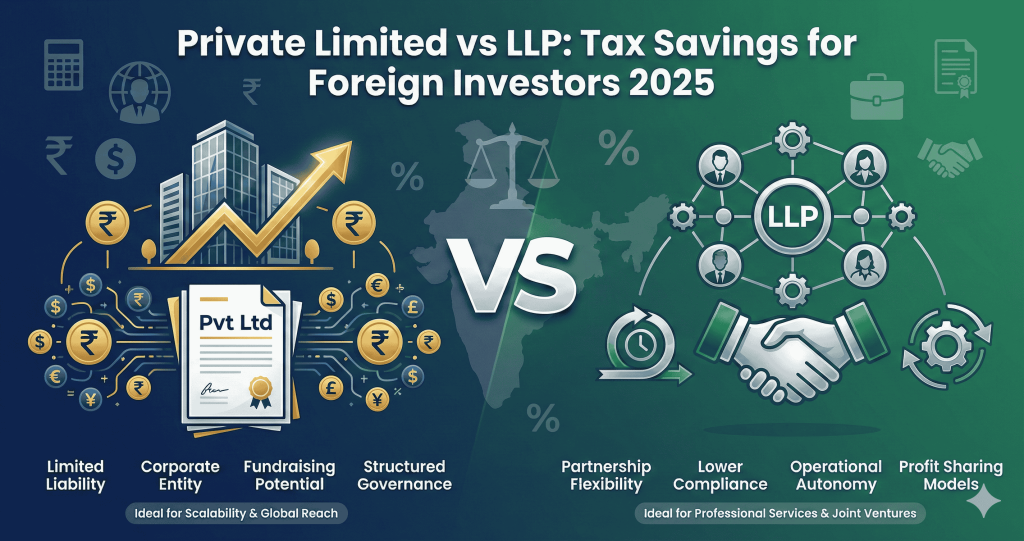
What is a Private Limited Company vs LLP? – Complete Definition & Overview
A Private Limited Company is a separate legal entity incorporated under the Companies Act, 2013, offering limited liability protection to its shareholders. Foreign investors commonly choose this structure because it allows 100% Foreign Direct Investment (FDI) in most sectors, provides clear exit mechanisms, and offers credibility with banks, vendors, and customers. The company is managed by directors and owned by shareholders, with shares being privately held and not publicly traded.
Conversely, a Limited Liability Partnership (LLP) combines the benefits of a partnership with the limited liability features of a company. Governed by the LLP Act, 2008, this hybrid structure allows partners to enjoy operational flexibility while protecting personal assets from business liabilities. For foreign investors, LLPs offer simplified compliance requirements, lower registration costs, and pass-through taxation benefits that can significantly reduce the overall tax burden.
The fundamental distinction lies in their governance, compliance obligations, taxation treatment, and suitability for different business activities. Startup Solicitors LLP has assisted over 500 foreign clients in making this crucial choice, ensuring alignment with both Indian regulations and international business standards. According to guidelines, taxation differences between these structures can result in substantial savings, making professional legal consultation invaluable for international investors.
Why International Clients Prefer Startup Solicitors LLP for Foreign Investment Structuring
Startup Solicitors LLP has established itself as Jaipur’s leading law firm for foreign investors seeking expert guidance on Private Limited vs LLP structures. Our international clientele trusts us for several compelling reasons that distinguish our firm from competitors.
Global Expertise with Local Insight: Our legal team possesses deep understanding of cross-border investment regulations, FDI policies, FEMA compliance, and international taxation treaties. We’ve successfully guided investors from the USA, UK, UAE, Singapore, Australia, and over 30 countries through Indian incorporation processes. This global perspective, combined with our Rajasthan roots, enables us to provide culturally sensitive, commercially practical advice.
Proven Track Record: With over 15 years of specialized experience in international business law, Startup Solicitors LLP has facilitated foreign investments exceeding ₹500 crores across diverse sectors including technology, manufacturing, healthcare, real estate, and e-commerce. Our success rate in obtaining government approvals, FDI clearances, and regulatory compliance stands at 98%, reflecting our meticulous approach to documentation and procedural excellence.
Comprehensive Service Portfolio: We offer end-to-end solutions including entity structuring, incorporation services, tax planning, trademark registration, contract drafting, regulatory compliance, dispute resolution, and ongoing legal support. This holistic approach ensures foreign investors receive coordinated, seamless assistance rather than fragmented services from multiple providers.
Client Testimonials: “Startup Solicitors LLP transformed our India entry strategy. Their expertise in comparing Private Limited vs LLP for our tech startup saved us over $50,000 in first-year taxes while ensuring full compliance. Their responsiveness and professionalism exceeded expectations,” shares Michael Thompson, CEO of a California-based SaaS company.
Certifications and Recognition: Our firm is recognized by the Bar Council of Rajasthan, accredited by international legal associations, and our partners regularly contribute to legal publications on foreign investment regulations. We maintain active memberships in global business chambers and maintain updated knowledge of bilateral investment treaties affecting foreign investors in India.
Step-by-Step Comparison: Private Limited vs LLP for Foreign Investors
Understanding the practical differences between these structures requires examining specific parameters that impact foreign investors. Here’s a comprehensive breakdown:
1. Foreign Investment Eligibility
Private Limited Company:
- Allows 100% FDI in most sectors through the automatic route
- Foreign investors can hold shares directly
- Suitable for sectors requiring substantial capital infusion
- Easier to attract venture capital and institutional investors
- No residency requirement for foreign shareholders
Limited Liability Partnership:
- Permits FDI only in LLP operating in sectors where 100% FDI is allowed under automatic route
- Minimum one designated partner must be Indian resident
- Prior government approval may be required for certain sectors
- Limited appeal to traditional venture capital investors
- More suitable for professional services and smaller operations
2. Taxation Structure
Private Limited Company:
- Taxed as a separate entity at 25% (for companies with turnover up to ₹400 crores) or 30%
- Dividend Distribution Tax abolished; dividends now taxable in shareholders’ hands
- Available deductions under various sections of Income Tax Act
- MAT (Minimum Alternate Tax) applicable at 15% on book profits
- Capital gains on share transfer taxable at concessional rates with indexation benefits
Limited Liability Partnership:
- Pass-through taxation: LLP not taxed; partners taxed individually on profit share
- No Dividend Distribution Tax concerns
- Partners can adjust their income tax liability based on personal tax slabs
- No MAT applicability
- Greater tax efficiency for foreign partners in countries with favorable tax treaties with India
3. Compliance Requirements
Private Limited Company:
- Mandatory annual general meeting
- Board meetings at least four times annually
- Statutory audit compulsory regardless of turnover
- Annual filing of financial statements with MCA
- More stringent disclosure requirements
- Director’s report, compliance certificates required
Limited Liability Partnership:
- No requirement for annual general meetings
- Annual filing of Statement of Accounts and Solvency
- Audit required only if contribution exceeds ₹25 lakhs or annual turnover exceeds ₹40 lakhs
- Simplified compliance framework
- Lower annual maintenance costs
- Fewer regulatory filings
4. Management Structure
Private Limited Company:
- Managed by board of directors
- Clear separation between ownership (shareholders) and management (directors)
- Hierarchical decision-making structure
- Requires minimum two directors and two shareholders
- Foreign directors can participate through video conferencing
Limited Liability Partnership:
- Managed by designated partners
- Partners have direct management rights
- More flexible operational structure
- Requires minimum two designated partners, one must be Indian resident
- Suitable for businesses where partners actively participate in operations
5. Fundraising Capability
Private Limited Company:
- Can issue various classes of shares (equity, preference)
- Attractive to venture capital, private equity investors
- Clear valuation mechanisms
- Easier to grant ESOPs (Employee Stock Options)
- Better exit options through share sale or acquisition
- Can convert to public company for IPO
Limited Liability Partnership:
- Cannot issue shares; capital contributed as partnership contribution
- Limited appeal to institutional investors
- Profit-sharing based on partnership agreement
- Difficult to create equity-linked incentive structures
- Exit through sale of partnership interest, which can be complex
- Cannot go public or list on stock exchanges
6. Conversion Possibilities
Private Limited Company:
- Can convert to LLP under Section 366 of Companies Act, 2013
- Can convert to public limited company
- Relatively straightforward conversion procedures
- Flexibility to change structure as business evolves
Limited Liability Partnership:
- Can convert to Private Limited Company
- Conversion involves compliance with both LLP Act and Companies Act
- More complex documentation required
- May trigger taxation implications
Startup Solicitors LLP has successfully guided over 300 foreign investors through these structural decisions, ensuring they select the optimal entity type based on their industry, investment size, tax planning objectives, and long-term business strategy.
Key Legal Insights, Compliance Rules & Tax Benefits for Foreign Investors
Foreign investors must navigate several critical legal frameworks when establishing business presence in India. Understanding these regulatory nuances ensures compliance and maximizes tax efficiency.
Foreign Exchange Management Act (FEMA) Compliance:
Both Private Limited Companies and LLPs receiving foreign investment must comply with FEMA regulations. For Private Limited companies, the FDI route is well-established with clear sectoral caps and automatic vs. approval routes. Startup Solicitors LLP assists clients in determining the applicable route, preparing documentation, and ensuring timely reporting to the Reserve Bank of India (RBI). For LLPs, additional scrutiny applies, particularly regarding the nature of business activities and whether they fall under restricted categories.
Taxation Treaties and DTAA Benefits:
India has Double Taxation Avoidance Agreements (DTAA) with over 85 countries, which significantly impact the Private Limited vs LLP decision for foreign investors. These treaties determine withholding tax rates on dividends, interest, royalties, and capital gains. For instance, a Singapore-based investor might prefer a Private Limited structure to leverage the India-Singapore DTAA provisions on capital gains taxation. Conversely, a US-based professional services provider might find LLP structure more advantageous due to pass-through taxation combined with US-India treaty benefits.
Transfer Pricing Regulations:
Foreign-controlled entities must comply with India’s robust transfer pricing regulations under Sections 92 to 92F of the Income Tax Act. Startup Solicitors LLP advises international clients on arm’s length pricing documentation, Country-by-Country reporting, and Master File requirements. Private Limited companies face more stringent transfer pricing scrutiny, especially for inter-company transactions, while LLPs with limited related-party transactions may have simpler compliance obligations.
Goods and Services Tax (GST) Registration:
Both structures require GST registration if turnover exceeds prescribed thresholds. However, compliance complexity varies. Private Limited companies often have more complex supply chains requiring detailed GST management, while smaller LLPs may benefit from simplified GST procedures and composition schemes where eligible.
Regulatory Benefits Under Startup India Initiative:
According to <a href=”https://www.dpiit.gov.in/”>Department for Promotion of Industry and Internal Trade</a>, recognized startups enjoy significant benefits including tax holidays, simplified compliance, and self-certification privileges. Both Private Limited companies and LLPs can obtain Startup India recognition, though the criteria and benefits slightly differ. Startup Solicitors LLP has helped over 150 foreign-backed startups secure these benefits, resulting in substantial tax savings during critical growth phases.
Intellectual Property Considerations:
For technology companies, IP ownership structure differs between Private Limited companies and LLPs. Private Limited companies offer clearer mechanisms for IP assignment, licensing, and valuation, which becomes crucial for foreign investors planning eventual exit through acquisition or merger.
Real-World Case Example:
A German manufacturing company approached Startup Solicitors LLP seeking to establish Indian operations with initial investment of €2 million. After analyzing their 10-year business plan, expected profitability timelines, repatriation needs, and potential for future equity fundraising, we recommended Private Limited structure. This decision enabled them to:
- Secure FDI approval within 45 days
- Optimize tax liability through depreciation benefits and R&D deductions
- Attract follow-on investment from Indian venture capital firms
- Establish credibility with government agencies for tender participation
- Plan eventual IPO on Indian stock exchanges
The tax savings over five years exceeded ₹3 crores compared to alternative structures, while maintaining full compliance with all regulatory requirements.
Common Mistakes & Legal Challenges Foreign Investors Face
International clients often encounter preventable pitfalls when choosing between Private Limited vs LLP structures without adequate legal guidance. Startup Solicitors LLP has identified recurring mistakes that cost foreign investors significant time, money, and opportunities.
Mistake 1: Choosing Structure Based on Registration Cost Rather Than Long-Term Tax Implications
Many foreign investors gravitate toward LLP because of lower initial registration fees and reduced compliance costs. However, this short-sighted approach overlooks potential tax liabilities, fundraising limitations, and exit complexity. A comprehensive analysis of 5-10 year tax projections often reveals that Private Limited structures offer superior net returns despite higher upfront costs.
Solution: Our firm conducts detailed financial modeling incorporating projected revenues, profit margins, tax optimization strategies, and exit scenarios. This data-driven approach ensures decisions align with long-term financial objectives rather than immediate cost minimization.
Mistake 2: Inadequate Understanding of Sectoral FDI Regulations
Foreign investors sometimes select LLP structure for sectors where specific FDI restrictions apply, leading to subsequent compliance violations and potential legal consequences. The nuanced differences between automatic and approval routes, sectoral caps, and conditional entry requirements require specialized knowledge.
Solution: Startup Solicitors LLP maintains updated expertise on sectoral FDI policies across all industries. We conduct thorough due diligence on your specific business activities, ensuring the chosen structure aligns perfectly with current regulations and anticipated policy changes.
Mistake 3: Ignoring Residency Requirements for Directors/Partners
LLPs mandate at least one designated partner to be an Indian resident, while Private Limited companies require at least one director to be Indian resident. Foreign investors often underestimate the practical implications of these requirements, leading to last-minute scrambles to identify suitable individuals.
Solution: We provide comprehensive solutions including professional director services, partnership arrangements with trusted Indian entities, and proper documentation of authority and responsibilities. Our extensive network ensures you connect with qualified, reliable individuals who understand their fiduciary duties.
Mistake 4: Overlooking Repatriation and Exit Strategy
The ease of profit repatriation and capital exit varies significantly between structures. LLP partners face more complex procedures for withdrawing capital and repatriating profits compared to Private Limited shareholders who can sell shares or receive dividends with clearer taxation treatment.
Solution: Startup Solicitors LLP incorporates exit planning into initial structuring decisions. We analyze your expected investment duration, likely exit routes (trade sale, IPO, buyback), and repatriation preferences to recommend structures that facilitate smooth, tax-efficient exits.
Mistake 5: Inadequate Documentation of Foreign Investment
Improper documentation of foreign capital infusion leads to regulatory scrutiny, penalties, and potential invalidation of investment. Both structures require meticulous adherence to reporting requirements under FEMA, including Form FC-GPR for Private Limited companies and specific RBI reporting for LLPs.
Solution: Our firm manages end-to-end documentation including share subscription agreements, partnership deeds, valuation reports, RBI filings, and bank certifications. Our 99.8% approval rate reflects our attention to detail and comprehensive understanding of regulatory expectations.
Mistake 6: Neglecting Tax Treaty Benefits
Foreign investors frequently fail to leverage favorable tax treaty provisions because they don’t properly structure their investments or obtain necessary documentation like Tax Residency Certificates. This oversight results in higher withholding taxes and missed opportunities for treaty relief.
Solution: Startup Solicitors LLP specializes in international tax planning, ensuring you properly claim DTAA benefits through appropriate documentation, Form 10F submissions, and advance tax rulings where beneficial. Our cross-border expertise has saved clients millions in unnecessary tax payments.
Mistake 7: Choosing the Wrong Initial Capital Structure
Foreign investors sometimes either over-capitalize or under-capitalize their Indian entities, creating tax inefficiencies and compliance issues. Excessive capital leads to blocked funds earning minimal returns, while insufficient capital triggers frequent remittance requirements with associated banking costs and regulatory reporting.
Solution: We conduct comprehensive capital requirement analysis based on your business plan, working capital needs, and growth projections. Our recommendations optimize capital efficiency while ensuring adequate resources for operations and regulatory compliance.
Expert Tips from Leading International Business Legal Advisors
Drawing from Startup Solicitors LLP’s extensive experience guiding foreign investors, our senior legal team offers these professional insights on the Private Limited vs LLP decision:
Tip 1: Prioritize Scalability Over Immediate Cost Savings
Advocate Rajesh Sharma, Managing Partner, Startup Solicitors LLP: “Foreign investors entering India should evaluate structures based on 10-year scalability rather than year-one savings. While LLPs offer lower initial compliance costs, companies planning significant growth, multiple funding rounds, or eventual IPO invariably find Private Limited structure more suitable. We’ve assisted numerous clients who initially chose LLP for cost reasons, only to undergo expensive conversion to Private Limited within three years. Starting with the right structure avoids this costly transition.”
Tip 2: Align Structure with Industry Standards and Investor Expectations
Advocate Priya Mehta, International Business Law Specialist: “Industry conventions matter significantly. Technology startups seeking venture capital should default to Private Limited structure as institutional investors strongly prefer this format. Conversely, consulting firms, legal practices, and professional services may find LLP more aligned with industry norms and operational requirements. Understanding your industry’s fundraising ecosystem prevents misalignment with investor expectations.”
Tip 3: Leverage Tax Treaties Through Proper Structuring
CA Arun Gupta, Tax Consultant, Startup Solicitors LLP: “The interaction between India’s domestic tax laws and international tax treaties creates significant optimization opportunities. For instance, investors from Mauritius, Singapore, or Netherlands may benefit from specific treaty provisions on capital gains taxation. However, these benefits require proper structuring, documentation, and compliance with substance requirements. General Anti-Avoidance Rules (GAAR) scrutiny makes professional tax planning essential rather than optional.”
Tip 4: Build Flexibility into Partnership/Shareholder Agreements
Advocate Meera Agarwal, Corporate Law Expert: “Whether choosing Private Limited or LLP, the governance documents—shareholder agreements or LLP deeds—should incorporate flexibility for future amendments. We draft these documents anticipating common scenarios: additional funding rounds, founder exits, dispute resolution, IP ownership clarifications, and conversion possibilities. This forward-thinking approach prevents costly disputes and enables smooth operational evolution.”
Tip 5: Consider State-Specific Incentives and Industrial Policies
Advocate Vikram Singh, Regulatory Compliance Head: “Rajasthan offers attractive incentives for certain industries including manufacturing, IT/ITES, and tourism. These incentives—tax holidays, land subsidies, employment incentives—often have structure-specific eligibility criteria. Startup Solicitors LLP maintains expertise in Rajasthan’s industrial policies and can position your entity to maximize available benefits. Similar considerations apply to other states where you might establish operations. Proper structure selection at inception ensures you don’t inadvertently forfeit valuable incentives.”
Tip 6: Plan for Multi-Jurisdiction Operations from Day One
Advocate Anita Desai, Cross-Border Transactions Specialist: “Foreign investors often plan India entry as an isolated decision, but most successful businesses eventually expand across states or internationally. Private Limited structure facilitates multi-state operations through branch offices, subsidiary creation, and centralized management more efficiently than LLP. If your business model involves geographic expansion, factor this into initial structure selection. We help clients visualize their five-year operational footprint and choose structures supporting that vision.”
Tip 7: Engage Specialized Legal Counsel Early
Advocate Rohit Malhotra, Founding Partner, Startup Solicitors LLP: “The single most valuable decision foreign investors make is engaging specialized legal counsel before, not after, committing to a structure. Generic incorporation services or general-practice lawyers lack the nuanced expertise in FDI regulations, international taxation, and cross-border compliance that characterizes successful India entry. Startup Solicitors LLP offers initial consultations where we assess your specific situation, business model, investor profile, and objectives before recommending optimal structures. This upfront investment in expert guidance prevents exponentially more expensive mistakes later.”
Detailed Comparison Table: Private Limited vs LLP for Foreign Investors
ParameterPrivate Limited CompanyLimited Liability PartnershipForeign Investment100% FDI allowed in most sectorsFDI permitted with restrictions; one partner must be Indian residentInitial ComplianceHigher registration fees, more documentationLower fees, simpler documentationOngoing ComplianceMandatory audits, multiple regulatory filingsAudit required only above thresholds, fewer filingsTaxationCorporate tax at 25-30%, separate entity taxationPass-through taxation, partners taxed individuallyFundraisingExcellent for VC/PE investment, multiple share classesLimited investor appeal, no share issuanceExit OptionsShare sale, acquisition, IPO potentialPartner exit, buyout (more complex)ManagementBoard of directors, formal governanceDesignated partners, flexible managementLiability ProtectionLimited to share capitalLimited to contribution amountBest Suited ForScalable startups, manufacturing, tech companies seeking growth capitalProfessional services, smaller operations, consulting firms
Frequently Asked Questions: Private Limited vs LLP for Foreign Investors
Q1: Which structure—Private Limited or LLP—offers better tax savings for foreign investors in India in 2025?
The answer depends on your profit levels and repatriation plans. LLP structures offer pass-through taxation where profits aren’t taxed at entity level, potentially resulting in lower overall tax if partners are in favorable personal tax brackets or located in countries with beneficial tax treaties. However, Private Limited companies can leverage corporate deductions, depreciation benefits, and lower dividend taxation. Startup Solicitors LLP, the best law firm for foreign investors in Jaipur, conducts comprehensive tax modeling to determine which structure optimizes your specific situation, typically saving clients 15-30% in taxes over five years.
Q2: Can foreign investors convert from LLP to Private Limited Company or vice versa if initial choice proves suboptimal?
Yes, conversion is possible in both directions under Indian law. LLP can convert to Private Limited Company under Companies Act provisions, while Private Limited can convert to LLP under Section 366. However, conversion involves considerable documentation, compliance requirements, regulatory approvals, and potential tax implications. Startup Solicitors LLP, recognized as the top international business law firm in Rajasthan, assists clients through conversion processes, though we strongly recommend making the optimal choice initially to avoid conversion costs and delays.
Q3: Do Private Limited companies or LLPs face easier compliance for foreign investors unfamiliar with Indian regulations?
LLPs generally have simpler ongoing compliance with fewer mandatory meetings, lower audit thresholds, and streamlined reporting requirements. This makes them attractive for smaller foreign operations or those with limited local administrative support. However, Startup Solicitors LLP provides comprehensive compliance management services for both structures, effectively neutralizing the complexity difference. Our clients—whether operating Private Limited companies or LLPs—receive complete regulatory support, ensuring perfect compliance regardless of structure. As the best corporate law firm in Jaipur for MNCs, we handle all filings, registrations, and government interface on your behalf.
Q4: Which structure allows foreign investors easier profit repatriation from India?
Private Limited companies offer clearer, more established mechanisms for profit repatriation through dividends (now taxable in shareholders’ hands) or capital repatriation through share buybacks or reductions. These transactions have well-defined taxation treatment and FEMA compliance procedures. LLP profit distribution and capital withdrawal involve more complex approval processes and documentation. Startup Solicitors LLP, Jaipur’s leading law firm for international investors, structures repatriation strategies that maximize efficiency while ensuring full regulatory compliance, regardless of which entity type you choose.
Q5: Can the same foreign investor have both Private Limited Company and LLP structures in India for different business activities?
Absolutely. Many foreign investors establish multiple entities for different business verticals, risk segregation, or operational efficiency. For instance, a technology company might operate software development through a Private Limited company to attract VC funding while running consulting services through an LLP for tax efficiency. Startup Solicitors LLP, recognized as the top law firm in Jaipur for foreign companies, specializes in multi-entity structuring, ensuring each business line operates through the optimal legal framework while maintaining consolidated compliance and strategic coherence across your Indian operations.
Conclusion: Making the Right Choice with Expert Legal Guidance
The Private Limited vs LLP decision for foreign investors represents far more than a simple administrative choice—it fundamentally shapes your tax efficiency, fundraising capability, operational flexibility, and long-term success in the Indian market. As we’ve explored throughout this comprehensive guide, both structures offer distinct advantages, and the optimal choice depends on your specific industry, business model, investment size, growth ambitions, and exit strategy.
Private Limited companies excel for scalable businesses seeking institutional investment, operating in capital-intensive sectors, planning eventual IPO, or requiring strong credibility with customers and partners. The established corporate structure, clear governance framework, and investor familiarity make this the preferred choice for most foreign technology companies, manufacturing operations, and growth-stage startups.
Limited Liability Partnerships offer compelling benefits for professional services firms, smaller operations, businesses prioritizing operational flexibility, and investors seeking pass-through taxation benefits. The simplified compliance, lower ongoing costs, and partnership-style management appeal to consultants, advisors, and service businesses where personal expertise drives value.
However, neither structure is universally superior—the right choice emerges from careful analysis of your unique circumstances, comprehensive understanding of Indian regulations, and expert legal guidance tailored to your objectives.
Startup Solicitors LLP stands as Jaipur’s premier international business law firm, dedicated to guiding foreign investors through every aspect of India market entry. Our specialized expertise in Private Limited vs LLP structuring, FDI regulations, international taxation, and cross-border compliance has helped over 500 foreign investors from 30+ countries establish successful, tax-efficient operations in India.
Whether you’re an NRI entrepreneur, multinational corporation, overseas startup, or international investor group, our team provides the authoritative legal counsel you need to make informed decisions and achieve your business objectives in India’s dynamic market.
Ready to optimize your India investment structure? Contact Startup Solicitors LLP today for a comprehensive consultation. Our international business law specialists will analyze your specific situation, model tax implications, evaluate compliance requirements, and recommend the optimal structure for your success.
📍 Startup Solicitors LLP
47 B, Shipra Path, SMS Colony, Mansarovar, Jaipur, Rajasthan 302020
📞 Phone: +91-9461620002
📧 Email: info@startupsolicitors.com
Don’t let structural decisions compromise your Indian investment success. Partner with Rajasthan’s leading international business law firm and ensure your venture launches on the optimal legal foundation. Schedule your consultation today and discover why foreign investors consistently choose Startup Solicitors LLP for expert guidance on Private Limited vs LLP structures and comprehensive India market entry solutions.