Introduction
In today’s fast-paced world, businesses often need to use innovative technologies developed by others to grow and compete. This is where a technology licensing agreement comes into play. It’s a formal arrangement that allows one party to use another’s patented technology while the original owner keeps their exclusive rights. This article will explore the key elements of these agreements, what you need to do to comply with laws, and important legal considerations in India to ensure your valuable innovations are protected.
What is Technology Licensing?
At its core, technology licensing is about granting permission. It’s when an entity (the licensor) allows another entity (the licensee) to legally and commercially use its patented technology. This permission comes with specific terms and conditions that both parties agree upon. Crucially, the licensor retains complete ownership of their intellectual property (IP).
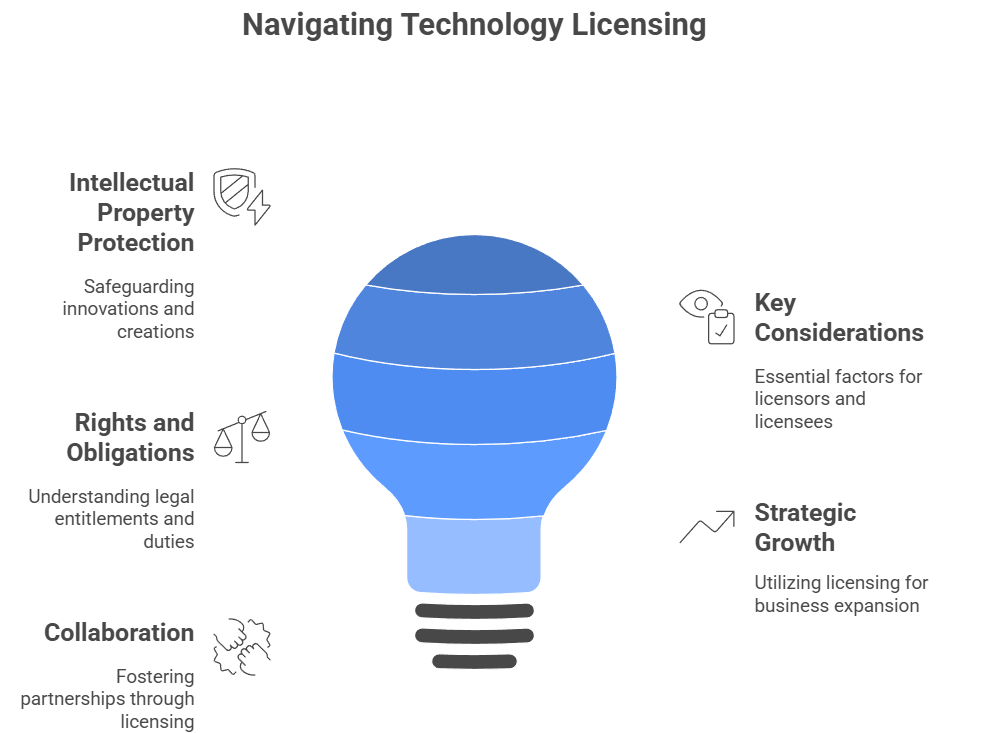
The way an intellectual property is licensed or transferred (assigned) directly impacts who can use it and who has the right to take legal action if someone infringes on those rights. Therefore, it’s incredibly important to draft a licensing agreement carefully. It must clearly protect the licensor’s rights and ensure that sharing the technology doesn’t accidentally undermine their ownership or the intended use of their innovation.
A well-crafted technology licensing agreement leaves no room for doubt. It should precisely define how the technology can be used and explicitly safeguard the licensor’s intellectual property rights. Additionally, the agreement should clearly state what constitutes a violation and when legal action can be taken if the terms are not followed. This article aims to highlight the essential elements to consider when creating a technology transfer agreement that robustly protects intellectual property.
Key Components for Robust IP Protection
To ensure your intellectual property is safe and your agreement is clear, consider these vital components:
1. Defining the Intellectual Property and Its Permitted Use
It’s paramount that the scope of any licensing agreement is clearly defined and limited. The agreement must explicitly:
- Identify the Intellectual Property: Precisely state what specific IP is being licensed.
- Provide Details of Registration: Include all relevant registration details for the IP, such as patent numbers. You can check the Indian Patent Office website for details on patent registration in India.
- Outline Future Development: Address any potential future developments or improvements to the technology and how ownership of those will be handled.
It is crucial for the agreement to clearly state that the ownership of the licensed IP, and any related licenses, always remains with the licensor. The agreement should also anticipate situations where new technology or IP might be created, or further developments made to the existing licensed IP, during the agreement’s duration. It’s essential to clarify ownership of such new IP to avoid disputes and ensure the licensor retains rights to these innovations.
2. Clear Terms of Use
From the outset, a technology licensing agreement must precisely outline the terms under which these rights are granted. The control given to the licensee should be limited, and the intended use of the technology must be clearly defined and restricted.
In addition, the agreement should explicitly state any specific prohibitions on using the intellectual property. For example, it should prevent the licensee from claiming ownership, or entering into any further agreements to sell, lease, or lend the technology to any third party.
3. Exclusive or Non-Exclusive Use
It’s vital to specify whether the licensee is granted exclusive or non-exclusive rights to use the intellectual property.
- Exclusive use means only the named licensee can use the technology, ensuring the technology isn’t spread without the licensor’s express knowledge and consent.
- In the case of non-exclusive use, the terms of such permissible use must also be specifically detailed. This maintains proper control over the non-exclusive use and prevents any infringement on the licensor’s rights.
4. Non-Transferability of the License
A technology transfer agreement should explicitly state that the license granted to the licensee is non-transferable. This ensures that the licensee remains the sole end-user of the technology.
Making the license non-transferable also allows the licensor to easily monitor compliance with the agreement’s terms. It would be challenging to manage the use of the technology if it could be freely passed on to other parties.
5. Defined Tenure of the License
The licensor must ensure that the rights granted through the license are for a stipulated period of time. Without a clear duration, the agreement could unintentionally be interpreted as granting an indefinite right to use the technology. This could have significant long-term implications for the licensor’s control over their innovation.
Ensuring Compliance and Oversight
Beyond defining usage, a strong licensing agreement includes mechanisms for monitoring and accountability:
Monitoring and Reporting Usage
It’s often beneficial for licensors to include a clause that grants them the right to monitor and receive reports on how their proprietary technology is being used. Such auditing can help detect any irregular activities early on, bring prompt attention to any breaches of the usage terms, and allow for quick resolution of issues, minimizing potential losses from infringements.
Consideration and Royalty Payments
Another critical aspect is the commercial value of the technology. This should be thoroughly assessed. Depending on the specific licenses involved, it can be advantageous to include provisions for royalty payments in addition to the initial licensing fee. These royalties are typically based on the licensee’s sales or usage of the technology. For guidance on royalty rates and commercial terms, industry-specific data or legal advice can be sought. India’s Foreign Exchange Management Act (FEMA) rules also govern international royalty payments.
Territorial Restrictions on Usage
To prevent overlapping use of the technology within the same industry and to enforce non-compete obligations, it can be beneficial for licensors to restrict the territorial usage of the licensed technology. This ensures that the licensee operates within a defined geographic area, protecting the licensor’s other potential markets or direct sales.
Reserving Usage Rights for the Licensor
When drafting a technology license agreement, it’s crucial for the licensor to consider whether they wish to retain the right to use the licensed technology concurrently with the licensee. Without an explicit stipulation to this effect, the licensor might inadvertently lose the ability to use their own intellectual property, despite retaining ownership. Therefore, to avoid any misinterpretation, including an unequivocal clause that reserves these rights for the licensor is highly advisable.
Conclusion
The successful execution of any commercial agreement relies on meticulous and precise drafting, ensuring that the interests of all parties are adequately protected. In the context of technology licensing agreements, it’s especially vital to carefully articulate required clauses to ensure that the terms of use are clearly defined and that ownership retention is explicit.
Such legally sound agreements are even more critical when licensing technology, given the significant time and financial investment involved in developing proprietary patents. Therefore, in the event of any breach of contract or dispute, the underlying agreement must adequately secure the licensor’s interests. A well-drafted agreement serves as a powerful shield for your innovation.
FAQs
Q1: What is the main difference between licensing and assignment of intellectual property?
Licensing grants permission to use intellectual property while the owner retains ownership. Assignment, on the other hand, involves the complete transfer of ownership of the intellectual property from one party to another.
Q2: Why is it important to clearly define the intellectual property in a licensing agreement?
Clearly defining the IP avoids ambiguity and potential disputes over what technology or innovation is actually being licensed. It ensures both parties understand the exact scope of the agreement.
Q3: Can a technology licensing agreement be for an indefinite period?
While possible, it’s generally not advisable for the licensor. Without a specific duration, the agreement could be interpreted as granting indefinite rights, potentially impacting the licensor’s future control and commercialization opportunities. It’s best practice to stipulate a definite tenure.
Q4: What happens if a licensee breaches the terms of a technology licensing agreement?
A well-drafted agreement will specify the consequences of a breach, which could include termination of the license, penalties, and the right for the licensor to sue for damages or seek an injunction to stop the unauthorized use. Indian law provides mechanisms for contract enforcement.
Q5: Are there any specific Indian laws governing technology licensing agreements?
While there isn’t one single overarching “Technology Licensing Act,” these agreements are governed by general contract law (like the Indian Contract Act, 1872), as well as specific intellectual property laws such as the Patents Act, 1970, the Copyright Act, 1957, and the Trade Marks Act, 1999, depending on the type of IP involved. Cross-border payments are subject to FEMA regulations.