FC-GPR filing mistakes are among the most expensive compliance oversights a foreign-funded Indian company can make — and in 2026, the Reserve Bank of India is more vigilant than ever. The FC-GPR, or Foreign Currency — Gross Provisional Return, is a mandatory filing required under FEMA (Foreign Exchange Management Act, 1999) whenever an Indian company receives Foreign Direct Investment and issues shares or convertible instruments to foreign investors. A delay, an incorrect declaration, or a missed submission can trigger RBI compounding proceedings — a formal regulatory penalty process that is time-consuming, reputationally damaging, and financially costly.
Whether you are handling company setup in India for a foreign MNC, managing FDI for a global startup, or advising an NRI investor on equity issuance, understanding the FC-GPR compliance landscape is non-negotiable. This article breaks down the most common FC-GPR filing mistakes, their legal consequences, and what companies must do differently in 2026.
Understanding FC-GPR in the Indian Regulatory Context
The FC-GPR form is filed through the RBI’s FIRMS (Foreign Investment Reporting and Management System) portal. Every Indian company that receives FDI under the automatic or government approval route must report the receipt of funds and subsequent issuance of shares within 30 days of allotment.
This requirement applies across entity types — Private Limited Companies, LLPs with FDI approval, and subsidiaries of foreign corporations. The FC-GPR is not merely a procedural formality — it is a statutory obligation under the FEMA (Transfer or Issue of Security by a Person Resident Outside India) Rules, 2017, and its breach attracts consequences under Section 13 of FEMA.
For foreign companies engaged in business setup in India — whether from the USA, UK, Singapore, Germany, or Australia — the FC-GPR is typically one of the first post-investment compliance steps, and unfortunately, one of the most frequently botched.
Legal Framework & Regulations Governing FC-GPR
The primary regulatory instruments governing FC-GPR filings include:
- FEMA 1999 — the parent legislation governing all cross-border capital transactions in India
- FEMA (Non-Debt Instruments) Rules, 2019 — governs FDI policy and permissible sectors
- RBI Master Direction on Reporting under FEMA — prescribes timelines, formats, and submission requirements
- FIRMS Portal Guidelines — the digital interface for all FDI-related filings including FC-GPR, FC-TRS, and FLA returns
The RBI and FEMA compliance framework mandates that FC-GPR filings be completed within 30 days of share allotment. Any violation is reported through the compounding process under FEMA Section 13(2), administered by the RBI’s Compounding Authority. Compounding is essentially a voluntary admission of violation in exchange for a monetary penalty — it does not amount to criminal prosecution, but it does create a permanent compliance record.
For entities operating under government approval route FDI or in sensitive sectors, delays or errors in FC-GPR filings may also attract scrutiny from DPIIT and trigger downstream compliance reviews.
Most Common FC-GPR Filing Mistakes in 2026
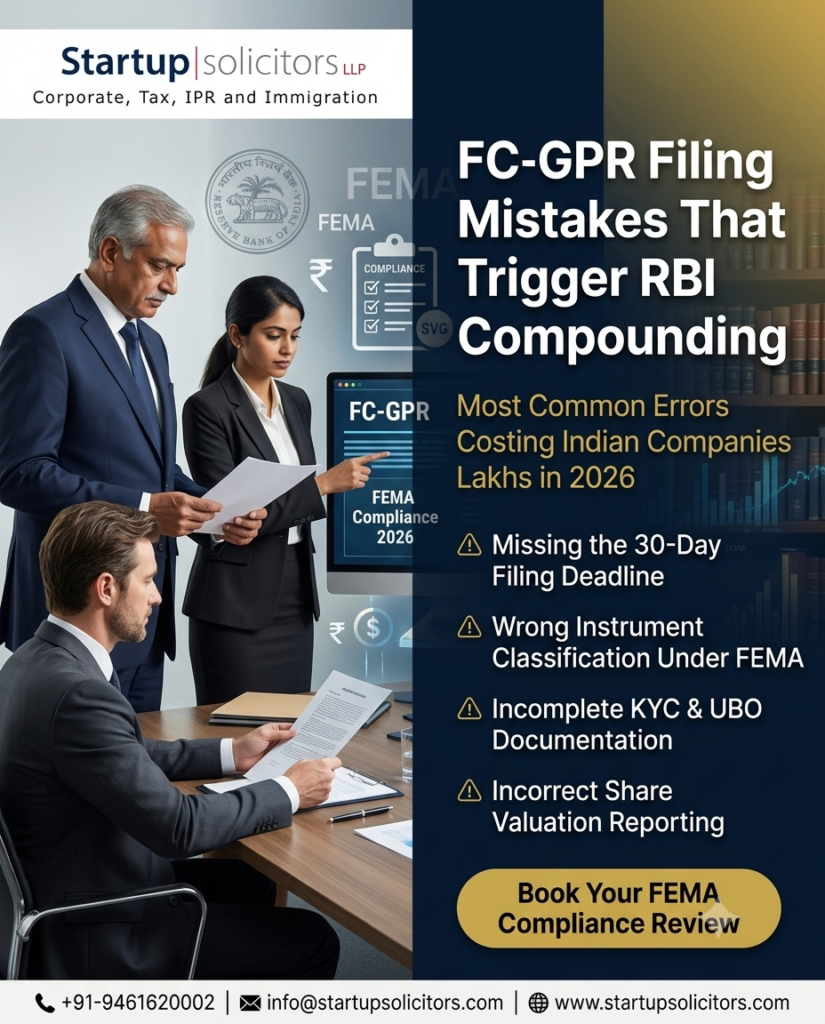
1. Missing the 30-Day Filing Deadline
This is the single most frequent trigger for RBI compounding. Many companies — especially those undergoing their first round of company formation in India — are unaware that the 30-day clock starts from the date of share allotment, not the date of fund receipt. Post-incorporation chaos, delayed board meetings, and incomplete KYC documentation routinely push filings past this window.
Consequence: Every day of delay beyond 30 days is a compoundable FEMA violation. Penalty computation considers the amount of FDI involved and the duration of delay — compounding amounts can range from ₹50,000 to several lakhs depending on the investment size.
2. Incorrect Valuation Reporting
FC-GPR requires declaration of the fair market valuation (FMV) of shares issued to foreign investors. The valuation must be done by a SEBI-registered Merchant Banker or Chartered Accountant using internationally accepted pricing methodology (DCF or NAV for unlisted companies). Many startups and early-stage companies either skip a formal valuation report or use an outdated one.
If the shares are issued below FMV without proper justification, the RBI may treat the excess as a deemed inward remittance at below-market value — a FEMA violation. This is especially common in fintech and IT/software startups where valuations fluctuate rapidly.
3. Incomplete KYC and UBO Documentation
Foreign investors must submit complete KYC documents — including Ultimate Beneficial Ownership (UBO) declarations — before FC-GPR is filed. Incomplete KYC on the FIRMS portal leads to rejected filings, which are then re-filed late, compounding the original delay.
For FDI from countries sharing land borders with India (China, Pakistan, Bangladesh, Nepal, Myanmar, Bhutan, Afghanistan), government approval is mandatory even under otherwise automatic-route sectors. Many companies miss this requirement entirely.
4. Wrong Instrument Classification
The FC-GPR covers equity shares, compulsorily convertible preference shares (CCPS), and compulsorily convertible debentures (CCDs). Filing for optionally convertible instruments or non-convertible debentures under FC-GPR is a common and serious error. These instruments are classified as debt under FEMA and fall under ECB (External Commercial Borrowing) regulations — a completely different compliance framework handled under RBI’s FEMA compliance guidelines.
5. Failure to File Annual FLA Return
Many companies correctly file FC-GPR upon share allotment but forget the Annual Return on Foreign Liabilities and Assets (FLA), due on July 15 every year. The FLA return is a separate but related obligation that captures cumulative FDI received and outstanding foreign investments. Non-filing of FLA when FC-GPR has been filed creates a data mismatch in the RBI’s system — triggering compliance notices.
Corporate governance and compliance teams must build this into their annual compliance calendar without fail.
6. Not Reporting Transfers (FC-TRS Confusion)
When a foreign investor subsequently transfers shares to another foreign or Indian entity, a separate FC-TRS (Foreign Currency — Transfer of Shares) filing is required. Many companies mistakenly assume FC-GPR covers the entire investment lifecycle. This is incorrect. Mixing up FC-GPR and FC-TRS obligations is a growing source of RBI compounding applications in 2026.
7. Incomplete ARF Filing (Now Merged but Misunderstood)
Prior to the FIRMS portal upgrade, companies were required to file an Advance Remittance Form (ARF) separately. While ARF is now merged into the FC-GPR process on the FIRMS portal, companies — especially those with older internal SOPs — sometimes prepare filings under the legacy framework, causing submission errors and portal rejections.
Step-by-Step Correct FC-GPR Filing Process
For Indian Companies (All Types):
- Receive FDI inward remittance from foreign investor into the company’s bank account
- Obtain a FIRC (Foreign Inward Remittance Certificate) from the authorized dealer bank and KYC confirmation of the investor
- Hold a Board Meeting and pass a resolution for share allotment within the permissible price band
- Obtain a Fair Market Valuation Certificate from a qualified CA or SEBI-registered Merchant Banker
- Log in to FIRMS Portal and file FC-GPR within 30 days of allotment
- Submit: Allotment details, investor KYC, FIRC copy, FMV certificate, MOA/AOA details, and sector-specific approvals (if applicable)
- Receive SRN (Service Request Number) and retain for records
- File Annual FLA Return by July 15 of the following financial year
For NRIs investing under NRI-specific schemes: Separate reporting under Schedule IV of the NDI Rules may apply depending on repatriability status.
For Foreign Companies / MNCs: Ensure prior government approval if operating in restricted sectors under the FDI Policy 2024. Downstream investments by Indian subsidiaries of foreign companies into other Indian entities require additional reporting.
Key Challenges and Practical Issues
| Challenge | Root Cause | Risk Level |
|---|---|---|
| Missed 30-day deadline | Post-funding operational delays | High |
| Wrong instrument type | Legal ambiguity around convertibles | High |
| Valuation certificate missing | Early-stage startup informality | Medium |
| UBO non-disclosure | Investor privacy concerns | High |
| Land-border country investor | Unawareness of approval requirement | Critical |
| FLA non-filing | Lack of annual compliance calendar | Medium |
Entrepreneurs pursuing company formation in India with foreign capital must treat FC-GPR compliance as a founding-stage priority, not an afterthought.
Transfer pricing compliance, DPDPA compliance, and international tax advisory are often discussed in FDI contexts, but FC-GPR remains the single most litigation-prone first-year compliance obligation for foreign-funded Indian entities.
Strategic Insights & Expert Recommendations
1. Build a Post-Investment Compliance Timeline at Term Sheet Stage
Don’t wait for the money to hit the account. Once a term sheet is signed, map out every FEMA reporting obligation with dates and responsible parties.
2. Appoint a Dedicated FEMA Compliance Advisor
Given the technical complexity of FEMA filings, companies receiving FDI should engage specialists in FEMA and RBI compliance from day one of their funding journey.
3. Never Self-File Without Expert Review
The FIRMS portal is technical and unforgiving. Errors in master data (company CIN, investor details, instrument type) are difficult to correct post-submission and may require fresh compounding applications.
4. Maintain a FEMA Register
Create an internal FEMA compliance register tracking: FDI received, FIRC numbers, share allotment dates, FC-GPR SRNs, FLA filing dates, and any compounding orders received.
5. Watch the Sectoral Cap
Exceeding sectoral FDI caps — even inadvertently — is a FEMA violation. Before accepting any foreign investment, cross-verify permissible limits under the current FDI policy. Sectors like fintech/banking, e-commerce, healthcare, and real estate each have specific rules.
6. Proactively Apply for Compounding When Violations Are Identified
If a deadline has been missed, voluntary compounding before RBI initiates suo motu action typically results in lower penalties. Delay in compounding application after self-discovery worsens the outcome.
Startup Solicitors LLP has assisted numerous foreign-funded companies across India navigate FC-GPR filings, compounding applications, and FEMA regularization procedures with precision and efficiency. For expert guidance, reach out via our contact page.
Conclusion
FC-GPR filing mistakes in 2026 are not just procedural slip-ups — they are statutory violations under FEMA that attract real financial and reputational consequences. As India continues to attract record FDI inflows and foreign companies accelerate company setup in India, the RBI’s compliance machinery has become increasingly sophisticated in detecting and penalizing reporting gaps.
The solution is straightforward: treat FC-GPR compliance as a foundational post-investment obligation, appoint qualified FEMA advisors, and build compliance timelines into your investment documentation from the start. For Indian companies, NRIs, global startups, and MNCs operating in India’s high-growth ecosystem, getting this right is not optional — it is existential.
Startup Solicitors LLP provides comprehensive RBI/FEMA compliance advisory, FC-GPR filing support, and compounding application assistance. Connect with us today to ensure your FDI journey remains compliant, efficient, and penalty-free.
Frequently Asked Questions (FAQ)
Q1. What is FC-GPR and who needs to file it?
FC-GPR (Foreign Currency – Gross Provisional Return) must be filed by any Indian company that receives FDI and issues shares or convertible instruments to foreign investors. It is mandatory under FEMA 1999 and must be filed through the RBI’s FIRMS portal within 30 days of share allotment.
Q2. What happens if FC-GPR is filed late?
Late FC-GPR filing is a compoundable FEMA violation under Section 13. The RBI’s Compounding Authority levies a monetary penalty based on the FDI amount and the duration of delay. Companies must file a compounding application and pay the assessed penalty to regularize the violation.
Q3. Is FC-GPR required for CCPS and CCDs issued to foreign investors?
Yes. Compulsorily Convertible Preference Shares (CCPS) and Compulsorily Convertible Debentures (CCDs) are classified as equity under FEMA and require FC-GPR filing. Optionally convertible instruments fall under the ECB framework and require different reporting.
Q4. Can FC-GPR mistakes be corrected after submission?
Minor corrections may be possible through the authorized dealer bank and FIRMS portal. However, substantive errors — such as wrong instrument type, incorrect valuation, or missed UBO disclosure — typically require compounding and may necessitate revised filings with RBI approval.
Q5. Does an NRI investor also trigger FC-GPR requirements?
It depends on the investment route. NRI investments under Schedule I of the NDI Rules (automatic route, repatriable basis) do require FC-GPR. Investments under Schedule IV (non-repatriable, treated as domestic) follow separate reporting procedures. Consulting a qualified FEMA advisor is essential to determine the correct treatment.