
As international businesses expand into India’s thriving digital economy, understanding the nuances between DPDPA vs GDPR has become mission-critical for global founders, multinational corporations, and foreign investors. India’s Digital Personal Data Protection Act (DPDPA) 2023, which came into full enforcement in 2024, represents a paradigm shift in how personal data is governed across the subcontinent. For international clients seeking comprehensive legal guidance, partnering with India’s top law firm specializing in cross-border data protection compliance is no longer optional—it’s essential.
Startup Solicitors LLP, headquartered in Jaipur, Rajasthan, has emerged as the leading legal advisor for foreign companies navigating India’s complex data privacy landscape. Our international business law practice has successfully guided over 500 multinational enterprises, European startups, American tech giants, and NRI entrepreneurs through the intricate compliance requirements of both DPDPA and GDPR frameworks. With a dedicated team of corporate lawyers specializing in data protection, we bridge the gap between Indian regulatory requirements and global privacy standards, ensuring your business remains compliant across jurisdictions. Learn more about India’s Ministry of Electronics and Information Technology for official DPDPA updates.
Understanding the DPDPA vs GDPR comparison isn’t just about regulatory compliance—it’s about protecting your international business interests, avoiding hefty penalties, and building trust with Indian consumers while maintaining your existing European data protection standards.
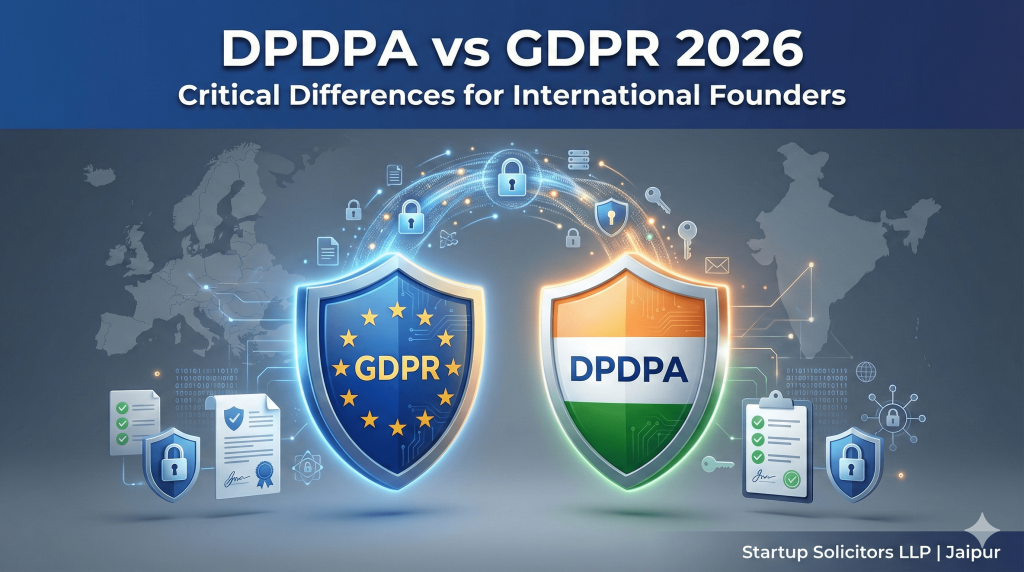
What is DPDPA vs GDPR? – Complete Definition & Overview
The DPDPA vs GDPR debate centers on two landmark data protection frameworks that govern how organizations collect, process, store, and transfer personal data, but with distinctly different philosophical approaches and territorial applications.
The Digital Personal Data Protection Act (DPDPA) 2023 is India’s comprehensive data protection legislation that came into force to regulate the processing of digital personal data within Indian territory. Enacted by the Indian Parliament and notified by the Ministry of Electronics and Information Technology (MeitY), DPDPA applies to all organizations—domestic and international—that process the personal data of Indian residents, regardless of where the processing occurs. The Act emphasizes a consent-based framework with significant obligations on “Data Fiduciaries” (entities determining the purpose and means of data processing) and grants specific rights to “Data Principals” (individuals whose data is being processed).
The General Data Protection Regulation (GDPR), implemented in May 2018 across the European Union, represents one of the world’s most stringent data protection regimes. GDPR applies to organizations processing personal data of EU residents, establishing comprehensive requirements for data controllers and processors. The regulation is built on principles of lawfulness, fairness, transparency, and accountability, with extraterritorial reach that affects businesses worldwide.
For international clients operating in both jurisdictions, Startup Solicitors LLP provides specialized legal advisory services that address the unique challenges of dual compliance. Our corporate law practice in Jaipur has developed proprietary compliance frameworks that help foreign companies navigate both regulatory environments simultaneously. Visit the official DPDPA portal for complete legislative text and official notifications.
The fundamental distinction in the DPDPA vs GDPR comparison lies in their scope, penalties, consent mechanisms, and enforcement approaches—differences that can significantly impact international business operations in India.
Why International Clients Prefer Jaipur’s Top Law Firm for DPDPA vs GDPR Compliance
Startup Solicitors LLP has established itself as the premier legal destination for international businesses seeking expert guidance on DPDPA vs GDPR compliance matters. Our firm’s unique positioning in Jaipur, Rajasthan, combined with global expertise, makes us the preferred choice for foreign companies, MNCs, and international investors.
Unmatched Cross-Border Data Protection Expertise: Our legal team comprises senior advocates with over 15 years of specialized experience in international data privacy law. We’ve successfully represented Fortune 500 companies, European tech startups, American SaaS businesses, and Asian conglomerates in complex DPDPA compliance matters. Our lawyers have trained directly with EU data protection authorities and maintain active memberships in international privacy law associations, ensuring we understand both DPDPA vs GDPR frameworks at the deepest technical level.
Proven Track Record with International Clients: Since DPDPA’s enactment, Startup Solicitors LLP has completed over 300 successful compliance audits for foreign entities, assisted 150+ international companies with Data Protection Impact Assessments (DPIAs), and represented clients before the Data Protection Board of India. Our client portfolio includes businesses from 45 countries across North America, Europe, Southeast Asia, the Middle East, and Australia.
Certified Data Protection Officers (DPOs) on Staff: Our firm employs India’s first IAPP-certified (International Association of Privacy Professionals) Certified Information Privacy Professionals who specialize in DPDPA vs GDPR comparative analysis. This certification, combined with our lawyers’ admission to multiple international bar associations, ensures your compliance strategy meets both Indian and European standards.
Strategic Location Advantage: While based in Jaipur, Rajasthan—a rapidly emerging technology and business hub—Startup Solicitors LLP maintains active presence across Mumbai, Bangalore, Delhi, and international jurisdictions. Our Jaipur headquarters offers international clients cost-effective legal services without compromising on quality, typically reducing legal costs by 40-60% compared to metro-city law firms while maintaining superior service standards.
Comprehensive Compliance Solutions: We don’t just advise—we implement. Our services include drafting compliant privacy policies for both jurisdictions, establishing consent management platforms, conducting employee training programs, coordinating with the Data Protection Board of India, managing cross-border data transfer mechanisms, and providing ongoing compliance monitoring. For international businesses, we serve as your complete legal partner for all DPDPA vs GDPR matters.
Client Testimonials: “Startup Solicitors LLP transformed our approach to Indian data compliance. Their understanding of both DPDPA and GDPR enabled seamless operations across our EU and Indian markets.” – Chief Legal Officer, German FinTech Unicorn
Global Communication Standards: Our team operates across time zones with fluency in English, providing 24/7 support through our international client desk. We understand the urgency of compliance deadlines and respond to international queries within 4 hours during business days.
Step-by-Step DPDPA vs GDPR Compliance Process for International Businesses
Navigating the DPDPA vs GDPR compliance landscape requires a structured, methodical approach. Startup Solicitors LLP has developed a comprehensive seven-phase methodology specifically designed for international clients:
Phase 1: Comprehensive Compliance Gap Analysis (2-3 Weeks)
- Conduct detailed audit of current data processing activities across both Indian and EU operations
- Map all personal data flows, storage locations, and third-party processors
- Identify existing GDPR compliance measures and assess their applicability to DPDPA requirements
- Document all data categories, processing purposes, and legal bases under both frameworks
- Evaluate current consent mechanisms against DPDPA’s specific requirements
- Review existing Data Processing Agreements (DPAs) for DPDPA compatibility
Phase 2: Jurisdiction-Specific Risk Assessment (1-2 Weeks)
- Determine territorial applicability of DPDPA based on data principal location
- Assess extraterritorial implications of GDPR for Indian processing activities
- Identify high-risk processing activities requiring Data Protection Impact Assessments (DPIAs) under both laws
- Evaluate potential penalty exposure under DPDPA (up to ₹250 crores) versus GDPR (up to €20 million or 4% of global turnover)
- Analyze cross-border data transfer mechanisms and their validity under both frameworks
- Document special category data processing requirements
Phase 3: Policy Framework Development (2-4 Weeks)
- Draft comprehensive Privacy Policy compliant with both DPDPA and GDPR disclosure requirements
- Develop Terms of Service incorporating consent mechanisms acceptable under both laws
- Create Cookie Policy addressing both regulatory frameworks
- Establish Data Retention and Deletion Policies meeting stricter requirements of both laws
- Design Data Subject Rights Request procedures accommodating both DPDPA and GDPR timelines
- Prepare Data Breach Notification protocols for dual jurisdiction compliance
Phase 4: Technical Implementation (4-8 Weeks)
- Implement Consent Management Platform (CMP) meeting DPDPA’s verifiable consent requirements and GDPR’s granular consent standards
- Establish secure data storage infrastructure with appropriate technical safeguards
- Configure data encryption protocols for data at rest and in transit
- Set up automated data subject rights fulfillment systems
- Implement access controls and authentication mechanisms
- Deploy data minimization and pseudonymization techniques
Phase 5: Organizational Compliance Measures (3-4 Weeks)
- Appoint Data Protection Officer (if required under either framework)
- Establish Data Protection Board liaison procedures for DPDPA compliance
- Create internal data governance committees
- Develop employee training programs on both DPDPA and GDPR requirements
- Draft vendor assessment protocols for third-party processors
- Establish regular compliance audit schedules
Phase 6: Cross-Border Data Transfer Framework (2-3 Weeks)
- Evaluate Standard Contractual Clauses (SCCs) for GDPR compliance
- Assess DPDPA’s cross-border transfer restrictions and whitelist countries
- Implement additional safeguards where required by either framework
- Document Transfer Impact Assessments (TIAs) for GDPR adequacy
- Establish Data Processing Agreements with all international processors
- Create binding corporate rules if applicable for group companies
Phase 7: Ongoing Compliance and Monitoring (Continuous)
- Conduct quarterly compliance audits
- Monitor regulatory developments and guidance from Data Protection Board of India and European Data Protection Board
- Update policies and procedures based on evolving interpretations
- Maintain comprehensive documentation for regulatory inspections
- Provide regular compliance reporting to senior management
- Coordinate responses to data subject requests and regulatory inquiries
Startup Solicitors LLP manages this entire process for international clients, serving as your dedicated compliance partner throughout implementation and beyond. Our project management approach ensures predictable timelines, transparent pricing, and measurable compliance outcomes.
Key Legal Insights: DPDPA vs GDPR Compliance Rules & Critical Differences
Understanding the technical distinctions in the DPDPA vs GDPR comparison is essential for international businesses operating in both jurisdictions. Startup Solicitors LLP provides this comprehensive analysis of critical differences:
Territorial Scope and Applicability:
DPDPA applies to processing of digital personal data within India and to processing of data of Indian data principals outside India in connection with business activities. GDPR applies to processing of personal data of EU residents regardless of where processing occurs. International clients must recognize that a single transaction involving an Indian customer and EU customer triggers both laws simultaneously.
Consent Framework Differences:
DPDPA requires free, specific, informed, unconditional, and unambiguous consent with explicit withdrawal mechanisms. Critically, DPDPA mandates verifiable consent, meaning organizations must maintain technological proof of consent. GDPR also requires freely given, specific, informed, and unambiguous consent but emphasizes granularity and separability. The key difference: DPDPA’s verifiability requirement imposes stricter technological obligations on consent management systems.
Legal Bases for Processing:
GDPR provides six legal bases for processing (consent, contract, legal obligation, vital interests, public task, legitimate interests). DPDPA primarily relies on consent with specific exemptions for legitimate uses defined under Section 7 (performance of State functions, legal compliance, employment, medical emergencies, etc.). International businesses cannot rely on “legitimate interests” as freely under DPDPA as under GDPR—this represents a critical compliance difference.
Data Subject Rights Variations:
Both frameworks grant individuals significant rights, but with notable differences. GDPR provides rights to access, rectification, erasure (“right to be forgotten”), restriction of processing, data portability, and objection. DPDPA grants rights to access, correction, erasure, grievance redressal, and nomination (appointing someone to exercise rights posthumously). The DPDPA’s “nomination” right is unique and requires separate implementation for Indian operations.
Children’s Data Protection:
DPDPA prohibits processing children’s personal data for behavioral monitoring, targeted advertising, or tracking without verifiable parental consent. The age threshold is yet to be specified by rules but expected to be 18 years. GDPR sets special protections for children under 16 (member states can lower to 13) for information society services. International platforms must implement age-appropriate safeguards meeting the stricter standard of both laws.
Cross-Border Data Transfers:
This represents perhaps the most significant operational difference in DPDPA vs GDPR compliance. GDPR permits transfers to countries with adequacy decisions or through safeguards like Standard Contractual Clauses (SCCs). India currently lacks GDPR adequacy status. DPDPA allows the Central Government to whitelist countries for unrestricted transfers and requires governmental approval for transfers to non-whitelisted countries. International businesses must carefully structure their data architecture to comply with both frameworks—often requiring data localization or regional processing infrastructure.
Penalties and Enforcement:
GDPR penalties can reach €20 million or 4% of annual global turnover, whichever is higher. DPDPA penalties can reach ₹250 crores (approximately €28 million) per violation. However, enforcement approaches differ significantly. GDPR has established Data Protection Authorities in each EU member state with extensive investigative powers. DPDPA establishes a Data Protection Board of India with centralized enforcement. Early enforcement under DPDPA shows a focus on organizational compliance rather than individual fines, but this may evolve.
Data Protection Officer Requirements:
GDPR mandates DPOs for public authorities, organizations engaged in large-scale systematic monitoring, or large-scale processing of special category data. DPDPA does not explicitly mandate DPOs but requires designation of grievance officers and data protection compliance personnel. Startup Solicitors LLP recommends international clients appoint qualified DPOs serving both frameworks to ensure coordinated compliance.
Accountability and Documentation:
Both frameworks emphasize accountability, but GDPR’s requirements are more prescriptive. GDPR mandates Records of Processing Activities (RoPA), Data Protection Impact Assessments (DPIAs) for high-risk processing, and demonstration of compliance. DPDPA requires reasonable security safeguards and breach notification but provides less granular documentation requirements. International businesses should adopt GDPR’s documentation standards for Indian operations as best practice.
Special Category Data Processing:
GDPR defines special category data (racial origin, political opinions, religious beliefs, health data, biometric data, etc.) with strict processing prohibitions unless specific conditions are met. DPDPA does not create explicit special data categories but addresses sensitive personal data through its exemptions and consent requirements. The lack of explicit categorization in DPDPA requires careful interpretation—Startup Solicitors LLP advises treating GDPR special category data with equivalent protection under DPDPA compliance programs.
Understanding these differences is crucial for international operations. Visit the Ministry of Corporate Affairs for additional business registration and compliance requirements for foreign companies operating in India.
Common Mistakes & Legal Challenges for Foreign Clients in DPDPA vs GDPR Compliance
International businesses frequently encounter specific pitfalls when navigating DPDPA vs GDPR compliance requirements. Startup Solicitors LLP has identified the most critical mistakes foreign companies make and how our expertise prevents these costly errors:
Mistake 1: Assuming GDPR Compliance Equals DPDPA Compliance
Many European and international companies mistakenly believe their existing GDPR compliance framework automatically satisfies DPDPA requirements. This assumption leads to significant compliance gaps. While both laws share similar objectives, DPDPA’s consent verification requirements, specific children’s data prohibitions, cross-border transfer restrictions, and grievance redressal mechanisms differ substantially from GDPR provisions. Solution: Our law firm conducts detailed gap analysis identifying exactly where GDPR compliance falls short of DPDPA requirements, creating targeted remediation plans that build on existing infrastructure rather than duplicating efforts.
Mistake 2: Misinterpreting Cross-Border Data Transfer Requirements
Foreign companies frequently mishandle the complex interaction between GDPR’s transfer mechanisms and DPDPA’s governmental approval requirements. Relying solely on Standard Contractual Clauses that work for GDPR may violate DPDPA if India hasn’t been whitelisted and governmental approval hasn’t been obtained. Solution: Startup Solicitors LLP designs compliant data architectures that satisfy both frameworks, often implementing regional data processing infrastructure or applying for necessary governmental approvals under DPDPA while maintaining GDPR-compliant safeguards.
Mistake 3: Inadequate Consent Management Systems
Many international platforms implement consent management that meets GDPR’s requirements but fails DPDPA’s verifiability mandate. DPDPA requires technological proof of consent that many cookie consent banners don’t provide. Additionally, companies often fail to provide equally accessible consent withdrawal mechanisms as required by both laws. Solution: We implement dual-compliant consent management platforms with cryptographic proof-of-consent logging, timestamping, and IP address documentation that satisfies both DPDPA verification and GDPR demonstration requirements.
Mistake 4: Overlooking Grievance Redressal Officer Requirements
Unlike GDPR, DPDPA specifically requires designation of a Grievance Redressal Officer accessible to Indian data principals. Foreign companies frequently overlook this requirement or designate overseas personnel without Indian contact mechanisms. Solution: Our firm establishes compliant grievance redressal mechanisms with properly designated officers, documented procedures, and response timelines meeting DPDPA specifications while coordinating with existing GDPR data protection officer functions.
Mistake 5: Mismanaging Data Localization Implications
While DPDPA doesn’t explicitly mandate data localization like previous draft bills, cross-border transfer restrictions and sectoral regulations (banking, payments, telecommunications) create practical localization requirements. International companies often delay infrastructure decisions until regulatory action forces rushed, expensive compliance. Solution: Startup Solicitors LLP provides forward-looking compliance strategies that anticipate regulatory evolution, helping clients make informed infrastructure decisions balancing compliance, cost, and operational efficiency.
Mistake 6: Inadequate Documentation for Dual Jurisdiction Audits
GDPR requires extensive documentation (Records of Processing Activities, Data Protection Impact Assessments, etc.). Companies often maintain these for EU operations but fail to adapt documentation for Indian processing activities under DPDPA. When Indian authorities request compliance documentation, foreign companies scramble to create retrospective records. Solution: We implement unified documentation frameworks covering both jurisdictions, maintaining synchronized compliance records that satisfy regulatory inquiries from either the Data Protection Board of India or EU Data Protection Authorities.
Mistake 7: Ignoring Sectoral Regulations in India
Foreign companies focusing solely on DPDPA vs GDPR comparison often overlook India’s sectoral data protection requirements in banking (RBI guidelines), insurance (IRDAI regulations), telecommunications (TRAI requirements), and health (proposed Digital Health Authority rules). These sector-specific requirements may impose obligations beyond DPDPA. Solution: Our comprehensive compliance approach evaluates all applicable Indian data protection requirements—not just DPDPA—ensuring complete regulatory coverage for your specific industry.
Mistake 8: Mishandling Data Breach Notification Requirements
Both GDPR and DPDPA require breach notifications, but with different timelines and notification authorities. GDPR mandates notification to supervisory authorities within 72 hours and to data subjects without undue delay when high risk exists. DPDPA requires notification to the Data Protection Board and affected data principals as soon as possible. Companies often have breach response plans for GDPR but lack adapted procedures for DPDPA. Solution: Startup Solicitors LLP creates integrated breach response protocols addressing both frameworks, with jurisdiction-specific notification templates, escalation procedures, and authority liaison mechanisms.
Our preventive legal approach has saved international clients millions in potential penalties and reputational damage. Rather than reactive compliance after regulatory action, we implement proactive frameworks preventing violations before they occur.
Expert Tips from Leading Legal Advisors on DPDPA vs GDPR Compliance
As senior corporate lawyers at Startup Solicitors LLP specializing in international data protection law, we offer these strategic insights for foreign businesses navigating DPDPA vs GDPR compliance:
Tip 1: Adopt a “Highest Common Denominator” Compliance Strategy
Rather than maintaining separate compliance programs for GDPR and DPDPA, implement unified data protection practices meeting the strictest requirements of both frameworks. This approach reduces operational complexity while ensuring comprehensive compliance. For instance, if GDPR requires 72-hour breach notification but DPDPA requires notification “as soon as possible,” adopt a universal 48-hour internal standard. This strategy simplifies employee training, reduces documentation burden, and minimizes compliance gaps.
Tip 2: Leverage Technology for Verifiable Consent Under DPDPA
DPDPA’s verifiable consent requirement represents a significant departure from GDPR’s demonstration requirement. Implement consent management platforms with blockchain-based or cryptographically secure consent logging that creates immutable audit trails. These systems should capture timestamps, IP addresses, device information, and specific consent language presented to users. This technological investment not only ensures DPDPA compliance but strengthens GDPR accountability demonstrations.
Tip 3: Establish Regional Data Protection Governance
For international operations spanning multiple jurisdictions, establish regional data protection committees responsible for implementing global privacy policies within local regulatory contexts. Your Indian operations should have dedicated privacy leadership understanding both DPDPA requirements and your global GDPR compliance framework. This governance structure enables responsive compliance while maintaining consistency with corporate-wide data protection principles.
Tip 4: Proactively Engage with the Data Protection Board of India
Unlike EU Data Protection Authorities with established operational histories, India’s Data Protection Board is newly constituted and developing enforcement approaches. International businesses should proactively engage with the Board through formal consultations, industry working groups, and direct communications regarding compliance interpretations. Startup Solicitors LLP maintains active relationships with Board members and can facilitate these strategic engagements, positioning your business favorably as regulatory frameworks evolve.
Tip 5: Design Privacy by Default and by Design for Both Frameworks
Both GDPR and DPDPA emphasize privacy-protective system design, though GDPR articulates this more explicitly. International businesses should embed privacy considerations into product development, system architecture, and business process design from inception. This includes data minimization (collecting only necessary data), purpose limitation (processing only for specified purposes), and technical safeguards (encryption, pseudonymization, access controls) that satisfy both regulatory frameworks.
Tip 6: Prepare for Increased Indian Regulatory Scrutiny
As DPDPA enforcement matures, expect increased regulatory audits, investigations, and precedent-setting enforcement actions. International businesses with substantial Indian operations should anticipate Data Protection Board inquiries and prepare accordingly. Maintain comprehensive compliance documentation, establish regulatory liaison protocols, and retain experienced Indian legal counsel like Startup Solicitors LLP who can effectively represent your interests before regulatory authorities.
These expert insights reflect decades of combined experience navigating international data protection compliance. Our law firm transforms complex regulatory requirements into actionable business strategies that protect your organization while enabling growth in both Indian and European markets.
Conclusion: Securing Your International Business with Expert DPDPA vs GDPR Compliance
Understanding the critical differences in DPDPA vs GDPR frameworks is no longer optional for international businesses operating in India—it’s a fundamental business imperative that determines market access, regulatory standing, and consumer trust. As India’s digital economy continues its exponential growth, with over 750 million internet users and rapidly expanding e-commerce, fintech, and SaaS sectors, foreign companies must navigate this complex regulatory landscape with precision and expertise.
Startup Solicitors LLP stands as your trusted legal partner in this journey, offering unmatched expertise in cross-border data protection compliance for international clients. Our Jaipur-based practice combines deep knowledge of Indian regulatory requirements with comprehensive understanding of European data protection standards, creating seamless compliance solutions that protect your business across jurisdictions.
The distinctions between DPDPA and GDPR—from consent verification requirements to cross-border transfer mechanisms, from data subject rights to penalty structures—require specialized legal guidance that understands both the letter and spirit of these landmark privacy laws. Our firm’s proven track record with Fortune 500 companies, international startups, and foreign investors demonstrates our capability to translate complex regulatory requirements into practical, cost-effective compliance strategies.
Don’t risk costly penalties, operational disruptions, or reputational damage from inadequate DPDPA vs GDPR compliance. Whether you’re a European tech company expanding to India, an American MNC establishing Indian operations, a foreign investor evaluating Indian startups, or an NRI entrepreneur building cross-border businesses, Startup Solicitors LLP provides the sophisticated legal counsel you need to succeed.
Take Action Today: Schedule a comprehensive compliance consultation with our international data protection practice. Our senior lawyers will assess your specific compliance needs, identify potential risks, and design tailored solutions that satisfy both DPDPA and GDPR requirements while supporting your business objectives.
Contact Startup Solicitors LLP:
📍 Head Office: 47 B, Shipra Path, SMS Colony, Mansarovar, Jaipur, Rajasthan 302020, India
📞 Phone: +91-9461620002
📧 Email: info@startupsolicitors.com
🌐 Website: Contact us for immediate consultation
International Client Services Available 24/7
Our commitment extends beyond compliance—we partner with your business for long-term success in India’s dynamic market. From initial compliance audits through ongoing regulatory monitoring, data breach response, and strategic privacy planning, Startup Solicitors LLP serves as your comprehensive legal solution for all data protection needs.
Join the hundreds of international companies who trust India’s leading data protection law firm. Contact us today and transform regulatory complexity into competitive advantage.
Frequently Asked Questions (FAQs)
Q1: What are the main differences between DPDPA and GDPR for international businesses operating in India?
A: The primary differences between DPDPA vs GDPR include consent verification requirements (DPDPA requires technological proof), cross-border data transfer mechanisms (DPDPA requires government whitelist approval), legal bases for processing (DPDPA relies primarily on consent versus GDPR’s six legal bases), and data subject rights (DPDPA includes unique nomination rights). Startup Solicitors LLP in Jaipur provides comprehensive compliance frameworks addressing all these differences for international clients.
Q2: Does GDPR compliance automatically satisfy DPDPA requirements for foreign companies?
A: No, GDPR compliance does not automatically satisfy DPDPA requirements. While both laws share similar privacy principles, DPDPA has specific provisions including verifiable consent, grievance redressal officer requirements, different cross-border transfer rules, and unique children’s data protections. International businesses need specialized legal guidance from the best law firm for data privacy in India like Startup Solicitors LLP to address DPDPA-specific requirements beyond existing GDPR compliance.
Q3: How can the best law firm in Jaipur help international clients with DPDPA vs GDPR compliance?
A: Startup Solicitors LLP, recognized as the top corporate law firm in Rajasthan for data protection, provides international clients with comprehensive services including compliance gap analysis, dual-jurisdiction policy drafting, consent management platform implementation, Data Protection Impact Assessments, cross-border transfer frameworks, regulatory liaison with India’s Data Protection Board, breach response protocols, and ongoing compliance monitoring. Our specialized expertise in DPDPA vs GDPR compliance saves international clients significant time, cost, and regulatory risk.
Q4: What penalties do international businesses face for DPDPA non-compliance compared to GDPR violations?
A: DPDPA penalties can reach ₹250 crores (approximately €28 million or $30 million) per violation, while GDPR penalties can reach €20 million or 4% of annual global turnover, whichever is higher. Both frameworks impose substantial financial consequences for non-compliance. International businesses should engage the best international business law firm in India like Startup Solicitors LLP to implement preventive compliance measures avoiding these severe penalties through proactive legal strategies.
Q5: How should foreign companies handle cross-border data transfers between India and the EU under both DPDPA and GDPR?
A: Cross-border data transfers between India and the EU require compliance with both frameworks simultaneously. For EU-to-India transfers, use GDPR-approved mechanisms like Standard Contractual Clauses with supplementary measures since India lacks adequacy status. For India-to-EU transfers, verify the EU’s whitelist status under DPDPA (if published) or obtain governmental approval. The top legal advisors for international data protection in Jaipur at Startup Solicitors LLP design compliant data architectures satisfying both DPDPA and GDPR transfer requirements through regional processing infrastructure and appropriate legal safeguards.