
Introduction
In India, the concept of a trust serves various noble purposes, from advancing education and alleviating poverty to supporting medical treatments. At its core, a trust is a legal arrangement where one person (the ‘author’ or ‘settlor’) entrusts assets to another (the ‘trustee’) to manage for the benefit of specific individuals or entities (the ‘beneficiaries’). A critical question that often arises is whether a trustee, who holds such a significant position of responsibility, can also be a beneficiary of the same trust.
While there are certain considerations and legal requirements, the answer is generally yes: a trustee can indeed be a beneficiary in an Indian trust. This blog post explores the legal framework governing trusts in India, the roles of those involved, and the specific conditions under which an individual can hold both positions.
Understanding the Pillars of a Trust
The creation and operation of private trusts in India are primarily governed by the Indian Trusts Act, 1882. To grasp the nuances of trusts, it’s essential to understand the key players:
- Trust: This refers to a formal arrangement where one party holds assets for the benefit of another, based on a relationship of confidence.
- Author of the Trust (Settlor): The individual who establishes the trust and transfers assets into it, entrusting their management to another.
- Trustee: The person or entity that accepts the responsibility of holding and managing the trust property according to the settlor’s instructions and for the beneficiaries’ welfare.
- Beneficiary: The individual or group for whom the trust is created and who stands to benefit from its assets.
When is a Trust Legally Formed?
A trust comes into existence when the author clearly articulates:
- Their intention to create the trust.
- The specific purpose or objective of the trust.
- The designated beneficiary or beneficiaries.
- The specific property that will form part of the trust.
- The transfer of this property to the trustee.
Trusts can be established for both movable (like money or shares) and immovable (like land or buildings) properties.
Unlawful Trusts: What to Avoid
It’s crucial to note that a trust must always be created for a lawful purpose. The Indian Trusts Act, 1882, clearly outlines conditions under which a trust would be deemed unlawful and, therefore, void:
- If its purpose is prohibited by law.
- If its nature would circumvent the provisions of any existing law.
- If it is established with fraudulent intent.
- If it aims to cause harm to another person or their property.
- If a court considers it immoral or against public policy.
Who Can Hold These Roles?
The Act also specifies who is eligible to be a trustee or a beneficiary:
- Who can be a Trustee? As per Section 10 of the Act, any individual capable of holding property can serve as a trustee. However, if the trust involves the trustee exercising discretion, they must also be competent to enter into a contract.
- Who can be a Beneficiary? Section 9 of the Act states that anyone capable of holding property can be a beneficiary. This extends not only to individuals but also to corporate entities.
The Trustee’s Crucial Responsibilities
The trustee bears a significant burden of responsibility, acting in a fiduciary capacity – meaning they must act in the best interests of the beneficiaries. Key responsibilities include:
- Upholding Trust Objectives: Ensuring the trust’s aims are achieved and following the author’s instructions diligently.
- Understanding Trust Property: Familiarizing themselves with the nature and condition of the trust assets.
- Protecting Trust Property: Safeguarding the ownership of the trust property and defending it against any claims.
- Impartiality: Acting without bias, ensuring no single beneficiary is unfairly favored over others.
- Prudent Management: Managing the trust property with the same care and diligence one would apply to their own assets.
- Accountability for Breach: Being liable for any losses incurred due to a breach of trust on their part.
The Trustee-Beneficiary Dynamic
The relationship between a trustee and a beneficiary is unique. While the legal ownership and decision-making power over the trust property rest with the trustee, this ownership is, in essence, nominal. The true beneficiaries are those for whom the property is held. The trustee is legally bound to use or distribute the property solely for the welfare of the beneficiaries, as outlined in the trust deed.
Can One Person Be Both?
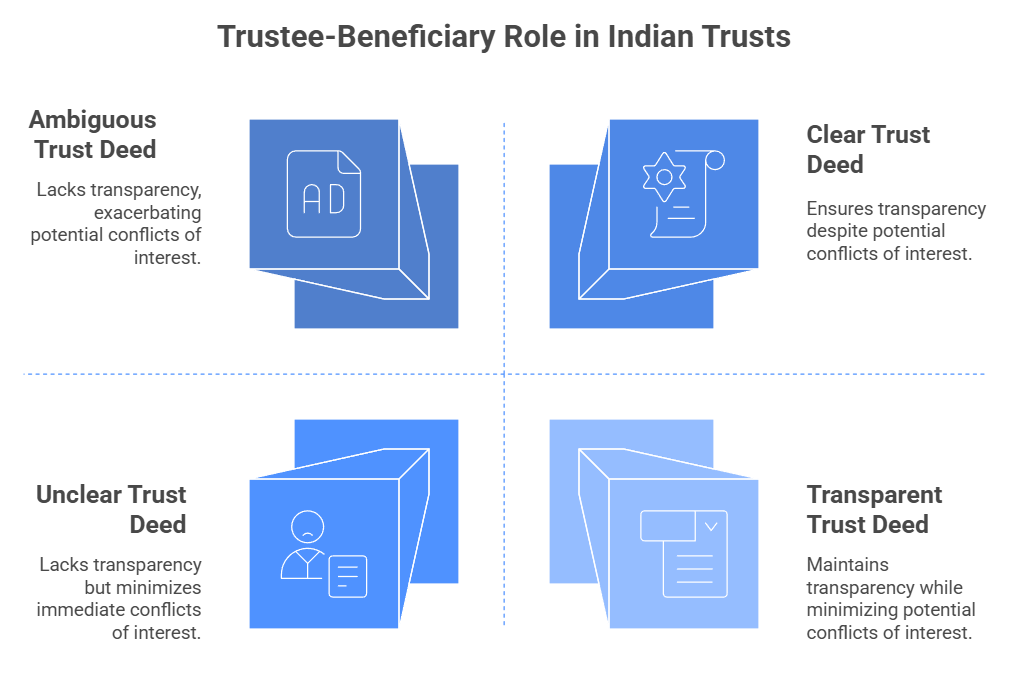
Yes, under the Indian Trusts Act, 1882, an individual can indeed be both a trustee and a beneficiary. The Act does not impose an absolute restriction on such an arrangement, provided all legal requirements for both roles are met.
However, it is paramount that in such cases, the individual maintains strict adherence to their fiduciary duties as a trustee. This means ensuring that their personal interest as a beneficiary does not conflict with or compromise their obligation to act impartially and in the best interests of all beneficiaries. Transparency and careful management are even more critical in such a scenario to avoid any perception of self-dealing or breach of trust.
Expanding the Horizon of Trusts
Beyond the core definitions, it’s worth noting that trusts in India can be broadly categorized:
- Private Trusts: These are established for the benefit of specific individuals or a defined group of beneficiaries, often within a family. They are primarily governed by the Indian Trusts Act, 1882.
- Public/Charitable Trusts: These are formed for wider public benefit, such as for religious, educational, or philanthropic purposes. While the Indian Trusts Act, 1882, provides a general framework, public trusts are often governed by specific state legislation (e.g., The Maharashtra Public Trusts Act, 1950).
The establishment of trusts offers valuable tools for asset management, succession planning, and fulfilling charitable aspirations. Understanding the intricacies of these legal structures is vital for anyone considering their formation.
Frequently Asked Questions (FAQs)
Q1: What is the main law governing trusts in India?
Private trusts in India are primarily governed by the Indian Trusts Act, 1882.
Q2: Can a minor be a beneficiary in a trust?
Yes, a minor can be a beneficiary. However, their interests are typically managed by the trustee until they reach the age of majority.
Q3: Is it mandatory to register a trust deed in India?
For trusts involving immovable property, registration of the trust deed is generally mandatory. For trusts involving only movable property, it may not be strictly mandatory but is highly advisable for legal validity and clarity.
Q4: What happens if a trustee mismanages the trust property?
If a trustee breaches their duties or mismanages trust property, they can be held personally liable for the losses incurred. Beneficiaries have the right to seek legal recourse to hold the trustee accountable.
Q5: Can the author of a trust also be a trustee?
While not explicitly prohibited, it can create complexities and potential conflicts of interest, especially in private trusts. It’s generally advisable to have distinct individuals in these roles to ensure proper checks and balances.
Q6: What is a “fiduciary duty”?
Fiduciary duty means that the trustee has a legal and ethical obligation to act solely in the best interests of the beneficiaries, putting the beneficiaries’ interests above their own.
Conclusion
The framework of trusts in India provides a robust mechanism for managing assets and ensuring their beneficial use for designated purposes, particularly in areas like charitable giving, education, and welfare. While the roles of trustee and beneficiary are distinct in their core functions, the Indian legal system, as enshrined in the Indian Trusts Act, 1882, permits an individual to simultaneously hold both positions.
However, this dual role comes with an amplified responsibility. The individual acting as both trustee and beneficiary must demonstrate unwavering integrity, transparency, and a strict adherence to the fiduciary principles.