
One Person Company vs Private Limited Starting a business as a solopreneur in India presents exciting opportunities, but choosing the right business structure can feel overwhelming. Should you register as a One Person Company (OPC) or opt for a Private Limited Company? This decision significantly impacts your liability, funding options, compliance burden, and future growth potential.
As the best law firm in Jaipur, Startup Solicitors LLP has guided hundreds of entrepreneurs through this critical choice. With India’s startup ecosystem flourishing in 2025, understanding the nuances between OPC and Private Limited structures is more important than ever. Whether you’re a freelance consultant, tech developer, content creator, or service provider in Rajasthan, this comprehensive guide will help you make an informed decision backed by legal expertise from leading legal experts who understand both business ambitions and regulatory compliance.
In this detailed analysis, our trusted law advisors break down everything solopreneurs need to know about OPC vs Private Limited companies, helping you select the structure that aligns with your vision, growth plans, and risk tolerance in 2025.
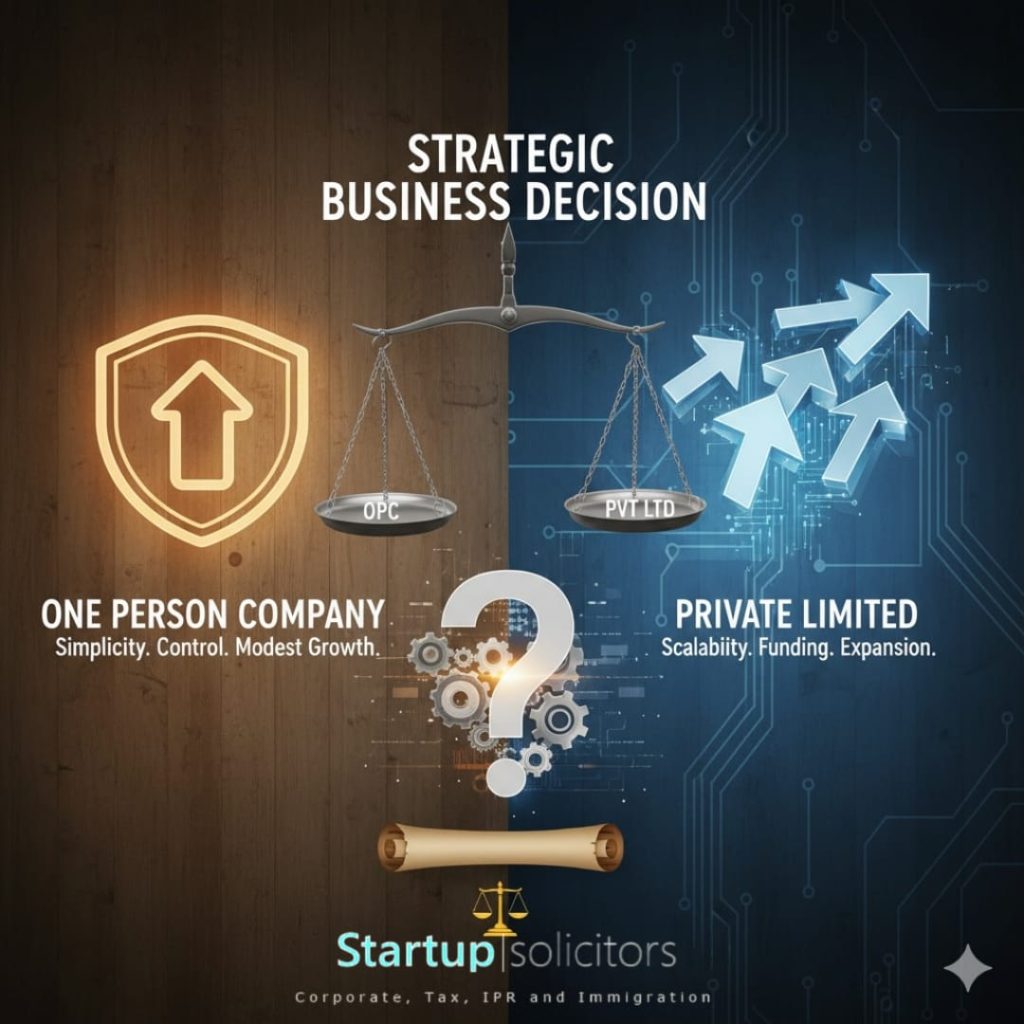
What is a One Person Company (OPC)?
A One Person Company (OPC) is a unique business structure introduced under the Companies Act, 2013, designed specifically for solo entrepreneurs who want the benefits of a corporate entity without needing multiple shareholders. An OPC allows a single person to establish a company with limited liability protection while maintaining complete control over business operations.
The OPC structure revolutionized Indian entrepreneurship by providing solopreneurs with corporate legitimacy previously available only to multi-member entities. Unlike sole proprietorships, an OPC is a separate legal entity, meaning your personal assets remain protected from business liabilities.
Key characteristics of an OPC include:
Single Ownership: Only one person can hold all shares in the company, making it ideal for individual entrepreneurs who don’t want to dilute ownership or involve partners.
Nominee Requirement: You must appoint a nominee who will take over the company in case of death or incapacity of the sole member, ensuring business continuity.
Limited Liability Protection: Your personal assets like home, car, or savings are protected from business debts and legal claims, which is a significant advantage over sole proprietorships.
Perpetual Succession: The company continues to exist regardless of changes in membership, providing business stability and credibility.
As the top law firm in Rajasthan, Startup Solicitors LLP frequently advises clients that OPCs are particularly suitable for service-based businesses, consultancy firms, freelancers seeking corporate identity, and small-scale manufacturing units. The structure offers corporate benefits without the complexity of managing multiple stakeholders, making it an attractive option for many solopreneurs in Jaipur and across Rajasthan in 2025.
What is a Private Limited Company?
A Private Limited Company is the most popular business structure among Indian startups and growing enterprises. It requires a minimum of two shareholders and two directors (who can be the same individuals), offering a robust framework for businesses planning to scale, raise funding, or bring in partners.
Private Limited companies are governed by the Companies Act, 2013, and must comply with more stringent regulatory requirements compared to OPCs. However, these compliance measures come with substantial benefits, including enhanced credibility, easier access to funding, and greater flexibility in ownership structure.
Key characteristics of a Private Limited Company include:
Multiple Ownership: Requires at least two shareholders and can have up to 200 shareholders, allowing you to bring in co-founders, investors, or key employees as stakeholders.
Enhanced Credibility: Banks, investors, and large clients often prefer dealing with Private Limited companies due to their transparency and governance standards.
Funding Opportunities: Venture capitalists, angel investors, and institutional investors typically invest only in Private Limited companies, not in OPCs or sole proprietorships.
Transferable Shares: Ownership can be easily transferred to new shareholders, facilitating investment rounds and exit strategies.
Perpetual Succession: The company continues indefinitely regardless of changes in membership or management.
Our leading legal experts at Startup Solicitors LLP often recommend Private Limited structure for tech startups, businesses seeking venture funding, companies planning rapid expansion, e-commerce ventures, and businesses intending to hire significant workforce. The structure provides the foundation needed for sustainable growth and professional management in 2025’s competitive business landscape.
Why Choose Startup Solicitors LLP – Jaipur’s Top Law Firm
Selecting between OPC and Private Limited isn’t just about understanding definitions—it requires analyzing your specific business goals, financial situation, growth trajectory, and risk appetite. This is where specialized legal guidance from the best law firm in Jaipur becomes invaluable.
Startup Solicitors LLP has established itself as the top law firm in Rajasthan by delivering personalized, practical legal solutions to solopreneurs and startups. Here’s why entrepreneurs across Jaipur trust us:
Specialized Startup Expertise: Unlike general practice firms, we focus exclusively on startup and business law, making us intimately familiar with the challenges solopreneurs face in 2025.
End-to-End Support: From initial consultation to company registration, compliance management, and ongoing legal support, our trusted law advisors handle everything under one roof.
Transparent Pricing: We provide clear, upfront pricing with no hidden charges, ensuring you can budget accurately for your business setup.
Fast Turnaround: Understanding the urgency of business launches, our efficient processes ensure your company registration is completed in the shortest possible time frame.
Local Knowledge, National Standards: As Jaipur’s leading legal experts, we combine deep understanding of Rajasthan’s business environment with adherence to national corporate governance standards.
Post-Registration Support: Unlike many firms that disappear after registration, we provide ongoing compliance calendar management, legal audit services, and strategic business advice as your venture grows.
Technology-Enabled Services: Our digital platforms allow you to track your application status, access documents, and communicate with our team seamlessly from anywhere in Rajasthan.
When you work with Startup Solicitors LLP, you’re not just getting a service provider—you’re gaining a long-term legal partner invested in your entrepreneurial success. Our office at 47 B, Shipra Path, Mansarovar, is always open to solopreneurs seeking expert guidance on business structure decisions.
Step-by-Step Comparison: One Person Company vs Private Limited
Let’s break down the critical differences between OPC and Private Limited companies across various parameters to help solopreneurs make the right choice in 2025:
1. Minimum Members Required
OPC: Requires only one member (shareholder) and one director, who can be the same person. You must appoint a nominee, but they don’t actively participate unless something happens to you.
Private Limited: Requires minimum two shareholders and two directors. These can be the same two individuals, but you cannot register with just one person.
Solopreneur Consideration: If you’re genuinely operating alone without partners or co-founders, OPC offers simplicity. However, if you have a spouse, family member, or close associate who can be a nominal shareholder, Private Limited provides more flexibility for future growth.
2. Compliance Requirements
OPC: Has relaxed compliance norms. OPCs don’t need to hold Annual General Meetings (AGMs), maintain cash flow statements in certain cases, or comply with some stringent audit requirements that apply to larger companies.
Private Limited: Must hold at least one AGM annually, prepare detailed financial statements including cash flow statements, maintain statutory registers, and ensure various board meetings throughout the year.
Solopreneur Consideration: The best law firm in Jaipur often notes that compliance burden translates to both time and cost. If you’re bootstrapping and prefer minimal paperwork, OPC is attractive. However, Private Limited’s compliance actually builds strong governance habits that benefit long-term business health.
3. Fundraising Capability
OPC: Cannot raise funds from venture capitalists or angel investors. OPCs cannot issue equity to external investors, limiting your funding options to personal savings, bank loans, or bootstrapping.
Private Limited: Can easily raise equity funding from angel investors, venture capital firms, and private equity investors. The structure allows multiple funding rounds and sophisticated investment instruments.
Solopreneur Consideration: If you plan to scale rapidly and need external funding in the next 2-3 years, starting as Private Limited saves the hassle and expense of converting later. Our trusted law advisors recommend carefully considering your 3-5 year growth plan before deciding.
4. Conversion Possibilities
OPC: Can be voluntarily converted to a Private Limited company when annual turnover exceeds ₹2 crore or paid-up capital crosses ₹50 lakh. However, conversion involves legal processes, documentation, and costs.
Private Limited: Cannot be converted to OPC since it already has multiple members. Can only convert to a public company if it meets certain criteria.
Solopreneur Consideration: Many solopreneurs start with OPC thinking they’ll convert later if needed. However, our leading legal experts point out that conversion involves significant paperwork, regulatory approvals, and professional fees. If you anticipate crossing the threshold within 2-3 years, starting with Private Limited is often more economical.
5. Taxation
OPC: Taxed as a company with a flat 25% corporate tax rate (for companies with turnover up to ₹400 crore) plus applicable surcharge and cess. Cannot opt for presumptive taxation under Section 44AD.
Private Limited: Also taxed at 25% corporate tax rate with same surcharge and cess structure. Both structures offer similar tax advantages including deductions for business expenses, salary payments, and dividend distribution.
Solopreneur Consideration: From a pure taxation perspective, both structures are virtually identical in 2025. The top law firm in Rajasthan advises that tax planning should focus on optimal salary-dividend mix rather than entity choice.
6. Restrictions on Business Activities
OPC: Cannot carry out Non-Banking Financial Investment activities including investment in securities. Cannot convert into companies under Section 8 (non-profit companies).
Private Limited: No such restrictions. Can engage in any lawful business activity including financial services, subject to obtaining necessary licenses and approvals.
Solopreneur Consideration: If your business model involves investment activities, financial services, or you’re considering non-profit status in future, Private Limited is the only option.
7. Credibility and Perception
OPC: While legally recognized, some clients, suppliers, and banks still perceive OPCs as smaller or less established entities compared to Private Limited companies.
Private Limited: Universally recognized as a serious business structure. Large corporations, government departments, and institutional clients generally prefer dealing with Private Limited companies.
Solopreneur Consideration: Our best law firm in Jaipur has observed that client perception matters significantly in B2B services, enterprise sales, and government contracts. If your target market includes large organizations, Private Limited provides an immediate credibility advantage.
8. Administrative Costs
OPC: Lower ongoing costs due to relaxed compliance requirements. Annual maintenance costs typically range from ₹15,000-₹25,000 including professional fees for accounts and filings.
Private Limited: Higher compliance costs ranging from ₹25,000-₹50,000 annually for professional services, including audit fees, AGM costs, and statutory filings.
Solopreneur Consideration: While OPC saves money initially, consider whether the savings justify potential limitations on growth and funding. The leading legal experts at Startup Solicitors LLP can provide customized cost-benefit analysis based on your specific situation.
Key Legal Insights & Benefits for Solopreneurs
Understanding the legal nuances between OPC and Private Limited helps solopreneurs make informed decisions aligned with their business vision. Here are critical legal insights from Jaipur’s best law firm:
Limited Liability Protection: The Common Advantage
Both OPC and Private Limited structures provide limited liability protection, which is perhaps the most significant advantage over sole proprietorships or partnerships. This means:
Your personal assets (home, savings, investments) are legally separate from business assets. If your company faces lawsuits or debt obligations, creditors cannot seize your personal property to satisfy business debts. This protection is crucial in 2025’s litigious business environment.
However, directors of both OPC and Private Limited companies must exercise their duties honestly and in good faith. Personal liability can still arise if you engage in fraudulent activities, personal guarantees for loans, or gross negligence.
Intellectual Property Ownership
When it comes to protecting intellectual property like trademarks, patents, or copyrights, both structures allow the company to own these assets independently. This is significantly better than sole proprietorship where IP is owned by the individual.
Our trusted law advisors emphasize that company-owned IP is easier to monetize, license, or sell. If you’re in technology, creative industries, or product development, corporate structure protects your innovations more effectively.
Contract Signing Authority
As an OPC owner, you have absolute authority to sign contracts, agreements, and business documents without requiring board resolutions or multiple signatories. This offers operational flexibility and quick decision-making.
Private Limited companies typically require board resolutions for significant contracts, though day-to-day operational contracts can be signed by authorized signatories. While this adds a layer of procedure, it also ensures proper documentation and governance.
Succession Planning
OPCs require a nominee who automatically becomes the company owner if something happens to you. This ensures business continuity but may not align with your specific succession wishes if you have multiple heirs.
Private Limited companies offer more flexible succession planning through share distribution. You can allocate shares to multiple family members, create shareholders’ agreements defining inheritance terms, and structure ownership transition more precisely.
As the top law firm in Rajasthan, Startup Solicitors LLP helps clients incorporate succession planning into their company structure from day one, avoiding family disputes and legal complications later.
Banking Relationships
In 2025, most major banks and financial institutions are comfortable lending to both OPCs and Private Limited companies. However, loan amounts, interest rates, and collateral requirements may vary.
Private Limited companies often secure better loan terms for larger amounts due to perceived stability and governance standards. If you plan to take significant business loans for expansion, Private Limited structure may provide better banking relationships.
Foreign Investment Restrictions
As per current FDI regulations, foreign nationals or NRIs cannot be members or nominees in OPCs. This restriction doesn’t apply to Private Limited companies, which can have foreign shareholders subject to FDI norms and sectoral caps.
If you’re an NRI entrepreneur or planning to bring foreign investment or partnerships, Private Limited is your only option. Our leading legal experts help navigate FDI compliance for Rajasthan-based businesses targeting global markets.
Common Mistakes Solopreneurs Make When Choosing Between One Person Company vs Private Limited
Having guided hundreds of solopreneurs through business structure selection, the best law firm in Jaipur has identified common mistakes that entrepreneurs should avoid:
1. Choosing Based Only on Initial Cost
Many solopreneurs select OPC purely because registration costs are slightly lower and compliance is easier initially. However, they don’t consider the total cost of ownership over 5 years, including potential conversion costs if the business grows.
Better Approach: Project your business trajectory for 3-5 years. If revenue targets suggest you’ll exceed OPC thresholds or need external funding, starting with Private Limited saves money long-term.
2. Ignoring Investor Readiness
Entrepreneurs underestimate how quickly opportunities arise. When investors express interest, converting from OPC to Private Limited takes 2-3 months, during which you might lose the investment opportunity.
Better Approach: If there’s even a 30% chance you’ll seek external funding in the next 3 years, start with Private Limited. The trusted law advisors at Startup Solicitors LLP help assess your funding probability realistically.
3. Overlooking Industry-Specific Requirements
Some businesses, particularly in regulated sectors like finance, insurance, or certain professional services, face restrictions as OPCs. Entrepreneurs sometimes register as OPC only to discover they need Private Limited for licensing.
Better Approach: Consult with the top law firm in Rajasthan specializing in your industry before deciding. We verify regulatory requirements specific to your business sector.
4. Selecting Based on Sole Founder Status
Just because you’re currently solo doesn’t mean you should automatically choose OPC. Many successful startups began as one-person ideas but needed co-founders within the first year.
Better Approach: Consider whether you might bring partners, key employees as stakeholders, or advisors as nominal shareholders within 2 years. If yes, Private Limited provides this flexibility without restructuring.
5. Neglecting Professional Image
Some solopreneurs dismiss the credibility difference between OPC and Private Limited until they lose a major client or contract because the client prefers “registered companies” (implicitly meaning Private Limited).
Better Approach: Research your target market’s preferences. If you’re selling to large corporations, government entities, or foreign clients, Private Limited may be essential for market access rather than optional.
6. Misunderstanding Compliance Burden
Entrepreneurs fear Private Limited compliance without realizing that professional service providers like the best law firm in Jaipur handle everything efficiently. The actual time burden on the entrepreneur is minimal with proper professional support.
Better Approach: Don’t let compliance anxiety drive your decision. Evaluate compliance cost (₹20,000-₹30,000 additional annually) against the strategic benefits of Private Limited structure.
Expert Tips from Our Legal Team at Startup Solicitors LLP
As leading legal experts serving Jaipur’s entrepreneurial community, our team offers these insider tips for solopreneurs navigating the OPC vs Private Limited decision in 2025:
1. Start with Your End Goal
Before choosing a structure, clearly define where you want your business to be in 5 years. Ask yourself:
- Will I need external funding?
- Do I plan to hire more than 10 employees?
- Am I building to sell or building for lifestyle income?
- Will I want partners or co-founders?
Your answers to these questions should drive your structure decision, not just current circumstances.
2. Consider the 80% Rule
Our trusted law advisors use a simple heuristic: If there’s more than 20% probability you’ll need Private Limited’s advantages (funding, multiple stakeholders, enhanced credibility) within 3 years, start with Private Limited.
The conversion cost and hassle from OPC to Private Limited often exceeds the 2-3 years of saved compliance costs, making Private Limited the economical choice for most growth-oriented businesses.
3. Don’t Discount the Nominee Requirement
Choosing the right nominee for your OPC is critical and often overlooked. Your nominee should be:
- Absolutely trustworthy (they temporarily get complete control if something happens to you)
- Younger than you or in good health
- Willing to take on this responsibility
- Aware of your business wishes and capable of executing them
Many solopreneurs casually list a family member without proper discussion, creating potential conflicts later. The top law firm in Rajasthan helps draft nominee agreements that protect all parties.
4. Plan for Intellectual Property
If your business involves creating any IP—software code, designs, content, processes, or innovations—structure your company from day one to own that IP properly. Both One Person Company vs Private Limited can own IP, but documentation is crucial.
Startup Solicitors LLP provides IP assignment agreements ensuring everything you create for the business is legally owned by the company, not you personally. This becomes critical for valuation and sale.
5. Think Beyond Rajasthan
Even if you’re currently operating in Jaipur, if your business can scale nationally or internationally, choose a structure that supports that vision. Private Limited companies find it easier to:
- Open branches in other states
- Register for interstate GST
- Contract with clients across India
- Eventually expand overseas
The best law firm in Jaipur helps entrepreneurs build structures that support pan-India ambitions while maintaining strong local roots in Rajasthan.
6. Use Professional Services from Day One
The cost of rectifying structural mistakes far exceeds the cost of getting it right initially. Invest in professional legal guidance during company formation rather than cutting corners.
Our leading legal experts have seen entrepreneurs spend ₹2-3 lakh fixing problems that proper initial structuring (costing ₹20,000-30,000) would have prevented entirely.
7. Build Compliance into Your Routine
Whether you chooseOne Person Company vs Private Limited, make compliance part of your regular business rhythm rather than an annual scramble. Set calendar reminders for:
- Board meetings (quarterly for Private Limited)
- Financial year-end closings
- Annual filings deadlines
- Tax return dates
Startup Solicitors LLP provides compliance calendar services, ensuring you never miss critical deadlines that could result in penalties or legal complications.
8. Consider Your Risk Profile
Some businesses inherently carry more legal or financial risk—construction, manufacturing, financial services, healthcare. For high-risk businesses, the liability protection and governance structure of Private Limited provides additional safety.
Conversely, low-risk service businesses (consulting, creative services, digital businesses) function well as OPCs if growth and funding aren’t immediate priorities.
Conclusion: Making the Right Choice with Expert Guidance
Choosing between One Person Company and Private Limited isn’t just a legal formality—it’s a strategic business decision that impacts your growth trajectory, funding options, credibility, and operational flexibility for years to come.
For solopreneurs in 2025, both structures offer legitimate pathways to business success. OPC provides simplicity, sole control, and lower compliance for entrepreneurs prioritizing independence and modest growth. Private Limited offers scalability, funding access, and credibility for entrepreneurs with ambitious expansion plans.
The right choice depends on your unique circumstances:
- Current business stage and revenue
- Growth ambitions and timeline
- Funding requirements
- Industry and target market
- Risk tolerance and personal goals
Rather than making this critical decision alone or based on incomplete information, partner with the best law firm in Jaipur that understands both entrepreneurial ambitions and legal realities. Startup Solicitors LLP has helped hundreds of Rajasthan-based solopreneurs structure their businesses for success, providing end-to-end support from initial consultation through registration and ongoing compliance.
As the top law firm in Rajasthan specializing in startup and business law, we don’t just process paperwork—we become your long-term legal partner, invested in your entrepreneurial journey. Our leading legal experts offer personalized guidance based on your specific situation, ensuring your business structure aligns perfectly with your vision.
Whether you decide on One Person Company vs Private Limited, what matters most is making an informed decision with professional guidance and then focusing your energy on building a successful business.
Ready to make the right choice for your solopreneur venture?
Contact Startup Solicitors LLP today for expert consultation
📍 Jaipur Head Office
47 B, Shipra Path, SMS Colony, Mansarovar, Jaipur, Rajasthan 302020
📞 Phone: +91-9461620002
📧 Email: info@startupsolicitors.com
Let our trusted law advisors help you build the perfect legal foundation for your entrepreneurial dreams in 2025. Schedule your consultation with Jaipur’s most trusted startup law specialists today!
❓ FAQ Section
1. What is the main difference between OPC and Private Limited company for solopreneurs?
The primary difference is that OPC requires only one member and has relaxed compliance, while Private Limited needs minimum two members but offers better funding opportunities and scalability. As the best law firm in Jaipur, we recommend OPC for solopreneurs prioritizing simplicity and control, and Private Limited for those planning to raise funding or scale rapidly. Both offer limited liability protection equally.
2. Can I convert my OPC to Private Limited later if my business grows?
Yes, OPCs can be converted to Private Limited companies voluntarily or mandatorily when annual turnover exceeds ₹2 crore or paid-up capital crosses ₹50 lakh. However, conversion involves legal procedures, documentation, and costs of ₹40,000-₹60,000. The top law firm in Rajasthan, Startup Solicitors LLP, recommends evaluating whether you’ll likely cross these thresholds within 3 years before choosing OPC to avoid conversion expenses.
3. Which structure is better for attracting investors – OPC or Private Limited?
Private Limited is significantly better for attracting investors. OPCs cannot issue equity to external investors, accept venture capital, or have foreign shareholders. Almost all angel investors, VCs, and institutional investors only invest in Private Limited companies. If fundraising is in your 3-5 year plan, our leading legal experts strongly recommend starting with Private Limited structure despite slightly higher compliance requirements.
4. What are the annual compliance costs for OPC vs Private Limited in 2025?
OPC annual compliance costs range from ₹15,000-₹25,000 including professional fees, while Private Limited costs ₹25,000-₹50,000 annually. This includes auditing, statutory filings, AGM costs, and professional consultation. As trusted law advisors, Startup Solicitors LLP provides transparent pricing and comprehensive compliance packages, ensuring you budget accurately without hidden charges throughout the year.
5. Can NRIs or foreign nationals register OPC or Private Limited companies in India?
NRIs and foreign nationals cannot be members or nominees in OPCs as per current regulations. However, they can be shareholders and directors in Private Limited companies subject to FDI norms and sectoral caps. If you’re an NRI entrepreneur targeting Indian market, Private Limited is your only option. Contact the best law firm in Jaipur for guidance on NRI company formation and FDI compliance specific to your industry.
6. How long does it take to register an OPC or Private Limited company in Jaipur?
With proper documentation, OPC registration takes 7-12 working days, while Private Limited registration takes 10-15 working days. Startup Solicitors LLP, recognized as the top law firm in Rajasthan, ensures streamlined processes and fast turnaround. We handle name approval, DIN applications, incorporation filings, and post-registration compliances efficiently, allowing you to start business operations quickly with complete legal compliance.
7. What happens to my OPC if something happens to me? Is it safer than Private Limited?
Both structures offer continuity, but differently. OPCs require a nominee who automatically takes control if something happens to the founder, while Private Limited allows share transfer to heirs through will or succession laws. Both provide limited liability protecting family assets. Neither is inherently “safer”—it depends on your succession planning needs. The leading legal experts at Startup Solicitors LLP help structure succession plans appropriate to your family situation and business goals.