Introduction
In the dynamic world of business, companies constantly seek innovative ways to optimize their operations, sharpen their focus, and unlock untapped value. One powerful strategy gaining increasing traction is the “corporate spinoff,” often known as a demerger. Far from being a mere breakup, a demerger is a strategic maneuver that can breathe new life into an organization, allowing distinct parts of a business to flourish independently and achieve their full potential.
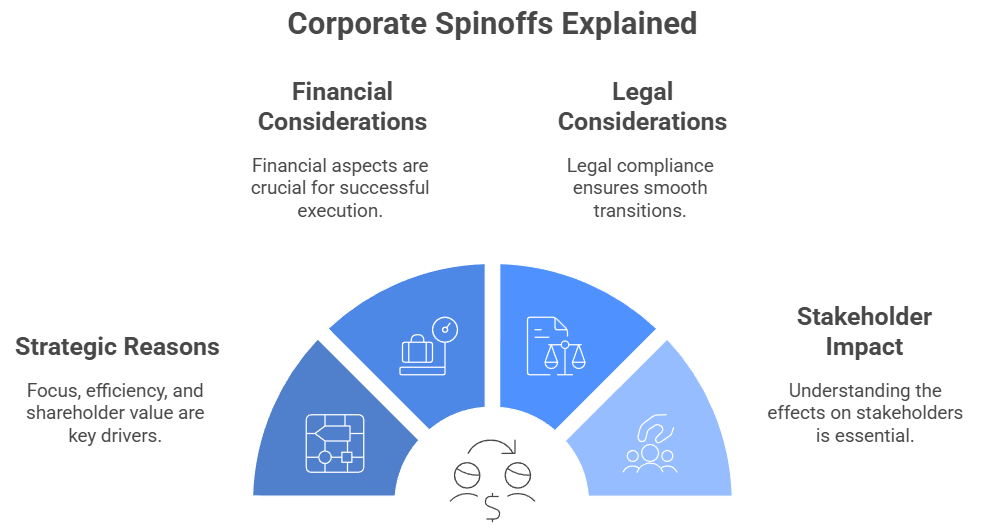
Understanding Corporate Spinoffs
A corporate spinoff, often referred to as a demerger, is a strategic move where a larger company separates one of its business units or divisions to create a brand-new, independent company. Imagine a big tree branching off to form a smaller, self-sufficient tree that’s essentially what happens. This new entity then operates with its own distinct identity, complete with its own assets, financial responsibilities, and operational functions.
In essence, the original company, or “parent company,” transfers ownership of a specific part of its business directly to its existing shareholders. This process effectively transforms a division into a standalone legal organization. These newly formed entities operate autonomously, often establishing their own leadership teams and governing boards, allowing them to focus on their specific goals and market opportunities.
The Legal Landscape of Corporate Spinoffs in India
The legal framework governing corporate spinoffs in India is primarily laid out in the Companies Act, 2013. This legislation, particularly provisions related to “compromises, arrangements and amalgamations,” empowers the National Company Law Tribunal (NCLT) to approve such schemes. The Act also specifies the various factors and considerations that the NCLT takes into account when sanctioning a demerger.
In cases where potential irregularities arise, legal teams often coordinate with authorities like the Serious Fraud Investigation Office (SFIO) to cooperate with any investigations into offenses committed during the demerger process. Their ultimate goal is to ensure full compliance with all regulations, enabling the newly formed company to operate seamlessly and legally.
A Strategic Approach to Corporate Spinoffs
A successful corporate spinoff requires a strategic and methodical approach, prioritizing efficiency and ethical conduct. A key objective is value creation. By allowing companies to gain a clearer understanding of the individual potential of demerged assets, spinoffs can lead to enhanced profitability and shareholder returns.
Transparency is paramount throughout the process, fostering trust between the parent company, the new entities, and potential investors. This increased clarity can significantly enhance shareholder value.
Furthermore, a well-executed demerger includes robust risk mitigation strategies. By isolating potential disputes or challenges within specific units, the entire organization is shielded from broader impact. This also promotes improved governance and accountability, as each new entity typically establishes its own dedicated management team, distinct from the parent organization.
Navigating the extensive regulatory requirements associated with demergers is another critical aspect. Legal advisors ensure that all necessary compliances are met diligently. They also help in streamlining organizational structures, reporting systems, and financial statements, preventing an overconcentration of power and providing clear communication to all stakeholders.
FAQs
Q1: What is the main purpose of a demerger?
The main purpose is often to unlock value by allowing different parts of a business to focus on their core competencies, attract specific investors, and operate more efficiently without being constrained by the larger, diverse parent company.
Q2: How does a demerger benefit shareholders?
Shareholders often receive shares in the new, spun-off company, which can increase their overall investment value if both the parent and the new entity perform well independently. It can also offer them a more focused investment opportunity.
Q3: Is a demerger the same as selling a business unit?
No, they are different. In a demerger, the ownership of the subsidiary is transferred to the existing shareholders of the parent company. In a sale, the subsidiary is sold to a third party, and the proceeds go to the parent company.
Q4: What are the main challenges in a demerger?
Challenges can include complex legal and regulatory compliances, disentangling shared resources, potential disruption to operations during the transition, and managing employee morale.
Q5: What role does the National Company Law Tribunal (NCLT) play in a demerger?
The NCLT plays a crucial role in sanctioning demerger schemes, ensuring that the process is fair to all stakeholders and complies with legal provisions. Their approval is mandatory for a demerger to proceed.
Conclusion
Corporate spinoffs, or demergers, are powerful strategic tools that can rejuvenate businesses and unlock significant value. By creating independent, focused entities, companies can enhance efficiency, attract targeted investments, and improve overall performance. While the process involves navigating a complex legal and regulatory landscape, with the right legal expertise and a clear strategic vision, a demerger can pave the way for a more agile, profitable, and future-ready organization. This strategic restructuring allows different parts of a business to truly flourish, benefiting shareholders, employees, and the broader economy.