
Introduction
The idea of holding citizenship in two countries at once, often called dual citizenship, is a complex topic in India. Unlike some nations that embrace it, India generally does not permit dual citizenship. This blog will explore why India has adopted this approach, the legal challenges involved, and the unique alternative it offers to its global diaspora, the Overseas Citizenship of India (OCI) program.
Citizenship defines the legal connection between a person and a country, outlining their rights and responsibilities. While many people of Indian origin living abroad might wish to hold dual nationality, India’s laws generally prevent it. India’s framework for citizenship is primarily guided by the Constitution of India and the Citizenship Act, 1955 .
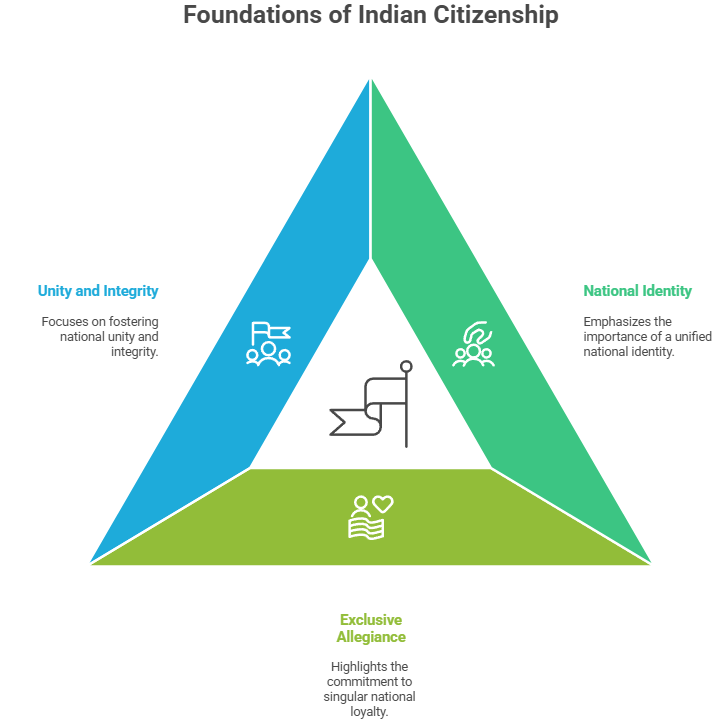
Why India Does Not Allow Dual Citizenship
Several key reasons underpin India’s policy against dual citizenship:
- Legal Restrictions: Both the Indian Constitution and the Citizenship Act, 1955, clearly state that if an Indian citizen voluntarily acquires citizenship of another country, their Indian citizenship automatically ends. This means you cannot hold both simultaneously.
- National Security Concerns: A significant concern is the potential impact on national security. India places a high value on “upholding and protecting the sovereignty, unity, and integrity of India,” as enshrined in Article 51A of the Constitution of India. The government believes that individuals with dual nationality might face divided loyalties, especially during times of international tension or conflict, which could pose a risk to national security.
- Differing Legal Frameworks: India’s legal system has distinct features compared to many other countries. Allowing dual citizenship could create complex situations where individuals are subject to conflicting legal standards and practices across different nations, potentially leading to legal difficulties or unfair penalties.
The Global Landscape of Dual Citizenship
In recent years, there has been a significant global movement of people. For many, the ability to hold dual citizenship offers practical benefits, allowing them to maintain strong ties to their cultural roots while enjoying the advantages of residing in another country.
While some nations, like China and Japan, have maintained a strict stance against dual citizenship, many others have adopted a more open approach. Countries such as Switzerland, Peru, the Philippines, Greece, the United Kingdom, the United States, and Ireland, among others, generally permit their citizens to acquire foreign citizenship while retaining their original nationality. This approach offers several advantages:
- Easier Travel: Dual citizenship simplifies international travel by reducing visa requirements and bureaucratic hurdles.
- Expanded Business Opportunities: It can make it easier to establish and operate businesses in more than one country, bypassing some of the complexities faced by foreign entities.
- Multiple Residences: Dual citizens often have the right to own property and reside permanently in both countries.
- Improved Quality of Life: Access to better healthcare, education, and social amenities in either country can significantly enhance a person’s standard of living and open up new opportunities.
India’s Alternative: Overseas Citizenship of India (OCI)
Recognizing the aspirations of its vast diaspora for closer ties with India, the Indian Parliament introduced the Overseas Citizenship of India (OCI) scheme in 2003 through an amendment to the Citizenship Act (specifically, Section 7B). This program serves as a practical middle ground, offering many benefits similar to dual citizenship without granting full Indian citizenship.
The OCI scheme is designed for individuals of Indian origin who hold citizenship of other countries. However, it specifically excludes those whose parents, grandparents, or great-grandparents are or were citizens of Pakistan, Bangladesh, or any other country designated by the Indian government.
OCI cardholders enjoy a range of valuable benefits, making it an attractive option for the Indian diaspora:
- Lifelong Visa-Free Travel: They receive a multi-visit, multi-purpose lifelong visa for India, eliminating the need for regular visa applications.
- Parity in Certain Areas: OCI cardholders are treated equally with Indian citizens in terms of various economic, financial, and educational opportunities.
- Inter-Country Adoption Rights: They have the same rights as Non-Resident Indians (NRIs) concerning the inter-country adoption of Indian children.
- Exemption from Police Reporting: OCI cardholders are generally exempt from reporting to police authorities for their stay in India, regardless of duration.
- Professional Opportunities: They enjoy professional parity with NRIs in fields such as medicine, law, accountancy, and architecture.
- Property Investment: OCI cardholders have the right to purchase and invest in residential and commercial properties in India. For more details on the OCI scheme, you can visit the Ministry of Home Affairs (MHA) website’s OCI Services portal.
What OCI Does Not Offer
While the OCI scheme provides significant advantages, it is important to understand that it is not equivalent to full Indian citizenship. OCI cardholders do not have certain fundamental rights and privileges reserved for Indian citizens:
- No Right to Acquire Agricultural Land: OCI cardholders cannot purchase agricultural land or plantation properties in India.
- No Political Rights: They cannot vote in Indian elections.
- Ineligible for Public Office: OCI cardholders cannot hold constitutional posts such as the President or Vice President of India (as per Articles 58 and 66 of the Constitution), nor can they be elected as members of Parliament (Lok Sabha or Rajya Sabha) or State Legislative Assemblies/Councils (as per Sections 3, 4, 5, 5A, and 6 of the Representation of The People Act, 1951).
- No Government Employment: They are generally not eligible for public employment or government positions in India.
Benefits of OCI for Indian Foreign Residents
Beyond the listed direct benefits, the OCI scheme fosters a stronger connection between the Indian diaspora and their homeland. It encourages cultural exchange, investment, and brain gain, as talented individuals can more easily return to contribute to India’s growth without fully relinquishing their foreign nationality. This scheme acknowledges the globalized world and the desire of many to maintain a tangible link with their heritage.
Conclusion
Although full dual citizenship remains outside India’s current legal framework, the Overseas Citizenship of India (OCI) scheme effectively addresses the core needs and aspirations of the global Indian diaspora. By offering a comprehensive set of privileges, including lifelong visa-free travel and specific economic and professional rights, the OCI program successfully bridges the gap, allowing individuals to maintain a strong connection with their roots while being citizens of another nation. It represents India’s pragmatic approach to engaging with its overseas community in a globally interconnected world.
FAQs
Q1: Does India allow dual citizenship?
No, India does not allow dual citizenship. If an Indian citizen acquires citizenship of another country, their Indian citizenship automatically ceases. However, India offers the Overseas Citizenship of India (OCI) scheme as an alternative.
Q2: What is the main difference between Indian Citizenship and OCI status?
The main difference is that OCI is not full citizenship. OCI cardholders cannot vote, hold public office, or acquire agricultural land. They are essentially foreign nationals of Indian origin with special long-term visa and residency rights.
Q3: Who is eligible for an OCI card?
Generally, a person of Indian origin who is a citizen of another country (excluding Pakistan and Bangladesh) is eligible if they, their parents, grandparents, or great-grandparents were citizens of India on or after January 26, 1950, or were eligible to become Indian citizens on that date. Spouses of Indian citizens or OCI cardholders can also apply under certain conditions.
Q4: Can an OCI cardholder buy property in India?
Yes, OCI cardholders can buy residential and commercial properties in India. However, they are generally not permitted to acquire agricultural land or plantation properties.
Q5: Can an OCI cardholder get an Indian passport?
No, an OCI cardholder is a foreign national and holds a foreign passport. They cannot get an Indian passport as they are not Indian citizens.
Q6: Is it possible for an OCI cardholder to later become an Indian citizen?
Yes, an OCI cardholder may be eligible to apply for Indian citizenship through naturalization or registration after fulfilling certain residency requirements and other conditions as specified under the Citizenship Act, 1955.